Category: politics

  • The Failure is a Corrupt Two-Party System, Not Electoralism

    The Failure is a Corrupt Two-Party System, Not Electoralism

    Can electoralism ever produce a transfer of power to the working-class in a two-party system, or are corrupt political parties that will never allow change into power, elections dominated by corporate interests, and voter suppression the problems? According to the theory of democratization, the wealthy autocrat class only willingly surrenders power in times of extreme economic recessions when a revolution by the working class is feared.Why then, is the oligarchy in developed nations such as the United States less responsive to the needs of the working class during times of economic trouble? When this fear of revolution fails, and elections remain unresponsive to the working class, plutocrats in developed nations also “buy off” the working class to prevent revolutions — in the form of super-PACS, corrupt independent party control and voter suppression.

    This quiet elite takeover of elections undermines the ability of the working-class to actually transfer government power to themselves. In fair, democratic elections, electoralism works. However, the corrupt, two-party system and Citizens United prevent electoralism from resulting in a transfer of power to the working class.

    The fundamental problems are an unresponsive two-party system that will never allow progressives calling for change into power, elections dominated by corporate interests, and voter suppression. Furthermore, a multiparty system must be explored.Plurality systems lean their fiscal policy towards more targeted programs and proportional systems towards more universalistic programs such as universal healthcare. A two-party system does not represent the 36% of independents, nor does it represent progressives.

    Elites have always modified endogenously economic and political institutions to enrich themselves and survive in power. It is only when specific circumstances arise when inclusive institutions may develop. However, the problem lies not in voting itself, but in the structure surrounding the voting system — the two-party system.

    Democracy (demo-cratia) — power by the people. A minimalist conception of democracy is an electoral democracy, but a maximalist requirement of democracy must reflect in policy outcomes. A minimalist concept holds to in order to avoid violent conflict resolution, the possibility of changing governments is allowed through voting. But how legitimate is the United States’ own electoral democracy? Does voter suppression corrupt the will of the people? Is our electoral implementation fair — free of violence, threats, or voter fraud? Do democracies even have higher standards of living/income?

    According to existing work, changes in democracy do not correlate with changes in income — there is no causal effect of income on democracy.

    Electoralism Occurs When Ruling Class Extend Franchise and Give Into Poor People’s Policy Needs

    According to the theory of democratization, the wealthy autocrat class only willingly surrenders power in times of extreme economic recessions when a revolution by the working class is feared. During times of extreme economic inequality, such as exists in autocracies, the poor can mount a revolution and the elite can establish a democracy thereby extending the franchise. Such was the case during the French Revolution when the peasants violently stormed the Bastille. Democratizations usually follow coups.

    While during times of democracy the elite can mount a coup to transfer power to themselves and produce favorable upper-tax bracket policies.

    Why then, is the oligarchy in developed nations such as the United States less responsive to the needs of the working class during times of economic trouble? This is because more equal societies are less likely to democratize and the poor are more likely to be content with redistribution. This is because the opportunity cost of a revolution is increased. American society has a higher political efficacy and faith in electoralism — which is actually undermined by party elites and voter suppression.

    Unresponsive Oligarchies Buy Off Democratization

    When this fear of revolution fails, and elections remain unresponsive to the working class, autocratic societies (like Singapore and Saudi Arabia) remain nondemocratic forever when the elite buy off the poor. While other countries such as Chile and Argentine, triggered by economic downturns, alternate between regime types.

    Plutocrats in developed nations also “buy off” the working class to prevent revolutions — in the way of party control and voter suppression. In less extreme cases, where a de-jure democracy is in place, the vote can be suppressed by the oligarchy and party bosses. The United States’ oligarchy  — in the country with the highest inequality among developed nations — simply suppresses working-class movements through independent party organizations such as the DNC and RNC to prevent a working-class takeover of the government. These parties can even legally pick a primary nominee without holding a single election.

     Or as was the case in the 2016 presidential election, they can rig the election as confessed by Donna Brazille and a court that conceded the DNC had the right to rig the 2016 primary against Sanders.  Is an election democratic when a candidate’s campaign gains control over the party’s finances and strategy a year before the election? Is it fair and free when a candidate gets leaked debate questions and her Clinton Foundation donors control the democrat’s media?

    So does the United States have a true electoral democracy in the sense that transferring government power is allowed? Or has the independent party control of the oligarchy powered by Super-PACS and voter suppression corrupted the process and prevented a transfer of power put forth by electoralist movements such as Our Revolution?

    A Corrupt Two-Party System Fails Us

    The problem isn’t electoralism, it’s the two-party system sustained by voter suppression and super-PAC funded candidates in  independent party organizations that can favor whatever nominee they want.

    It is a serious party problem when the DNC tells a court that they are a “private corporation” with no obligation to follow their own rules because the primary election belongs to the party elites not voters.

    Polling site closures and 6-hour-long lines also seriously contest the legitimacy of our democracy.

    Yet the problem still isn’t electoralism, it’s a corrupt, undemocratic two-party system that influences elections through super-PACS and candidate funded media. This quiet elite takeover of elections undermines the ability of the working-class to actually transfer government power to themselves under the theory of democratization. In normal, democratic elections, electoralism works. However, the corrupt two-party system and Citizens United prevent electoralism from resulting in a transfer of power to the working class in fear of revolution. In a de-jure representative democracy like the United States, elite are just covertly  “buying off” elections to prevent a transfer of power just as autocracies do.

    The Real Solution to Transferring Power Back to Americans

    Electoral democracies are systems that avoid violent conflict resolution by fairly and freely allowing elections through voting. When electoralism fails to produce a transfer of power even under dire economic circumstances, the fairness of the institutions conducting the elections is called into question. The problems are fundamentally an unresponsive two-party system that will never allow progressives calling for change into power, elections dominated by corporate interests, and voter suppression.

    The solution isn’t throwing away the liberal democracy — it’s fixing the underlying foundational problems of voter suppression, Citizens United, and corrupt parties that aren’t resulting in a transfer of power. A liberal democracy has to be guaranteed by universal suffrage and freedom in electoral implementation with no violence or voter suppression plaguing it.

    Furthermore, a multiparty system must be explored.Plurality systems lean their fiscal policy towards more targeted programs and proportional systems towards more universalistic programs such as universal healthcare. A two-party system does not represent the 36% of independents, nor does it represent progressives. However, there exists a tradeoff between the accountability of a two-party (plurality) system and representation of a proportional system. Wherein a proportional system lacks accountability — no one will discipline a politician if they disappoint even just 1% of a group — they will just lose one member. Not like under plurality rule. While in a plurality system a candidate can win by 51%, but who will represent the remaining 49% of the constituency?

    The solution isn’t retreating into a 15 member Lenin book club and dreaming about a morally reprehensible “revolution,” it’s overturning Citizens United, fixing the corruption of the two party system, and eradicating voter suppression. 

  • Eco-fascism: Humanity is Not The Problem, Neoliberalism Is

    Eco-fascism: Humanity is Not The Problem, Neoliberalism Is

    The spread of the COVID-19 pandemic has not only revealed the inherent, exploitative economic failures of an unfettered free market, but also, the environmental failures of capitalism as decreased fossil-fuel activity has cleared the air pollution in Asia, and canals in Italy. Yet there has been a rising online sentiment pinning global environmental deterioration on to inherent human nature –when the global temperatures were normal in a pre-industrial era. ‘Mother nature is waking up, humans are the virus,’ pseudo-woke Twitter users share, amassing hundreds of thousands of likes and engagement.The idea that humans are a virus that can not coexist with nature absolves neoliberalism of its decades of market failures, it absolves the 100 companies responsible for 71% of global emissions of their blame for global warming. Native Americans have conserved and coexisted nature for thousands of years. The problem is not humanity, it’s neoliberalism, which through deregulation and resistance against a transition towards a 70-85% renewable system, demands the perpetuation of an economy run on fossil fuels. The environment has been the sacrificial lamb of neoliberalism since the 19th century — forgoing environmental health in favor of industrial progress.

    Environmental History: Normal CO2 Levels in The Pre-Industrial Era 

    The nihilist, defeatist blaming of environmental deterioration on “humanity” is an intellectually lazy cop-out. It’s a way to absolve neoliberalism of its responsibility in creating the environmental crisis and absolve ourselves of the responsibility of transforming the global energy industry. Producing fossil fuel emissions isn’t a natural trait of humanity — it’s a trait of capitalism, deregulation, and the fossil fuel industry. There is another way. To simply throw our hands in the air and declare, “oh well, humans are evil destructors,” is the easy and dishonest option. It is ecofascism.

    Environmental history shows that humans — who have lived on the planet for 200,000 years — only managed to create a global warming crisis in the last 150 years with the advent of industrial capitalism. How has human activity harmed the environment? The most pressing environmental problems of our time—such as deforestation, water pollution, and global warming—are the results of human activities.

    The pre-industrial climate is proof that environmental destruction is not a feature of humanity, but rather, a feature of post-industrial neoliberalism. Human interaction with nature since the post-revolutionary age of fossil fuels from 1800-present, has been primarily destructive. The Industrial Revolution marked the start of the gradual rise in CO2 emissions. Studies have found that climate change signs first appeared as early as the 1830s.

    Human influence aside, internal and external forces such as internal heat transfer within the Earth, volcanic eruptions, and variability in the amount of energy emitted by the Sun cause the climate to vary. Scientists, taking this into account, define the pre-industrial baseline relative to 1850-1900. This is why climate accords like the Paris Agreement seek to limit the global average temperature to below 2℃ above pre-industrial levels and to pursue efforts to limit the temperature increase to 1.5℃ above pre-industrial levels.

    Human activities are estimated to have caused approximately 1.0°C of global warming above pre-industrial levels, and the IPCC forecasts that we will reach the 1.5°C threshold between 2030 and 2052 because we will not meet the net-zero CO2 emissions goal by 2050 by dropping 45% from the 2010 levels by 2030. To achieve this renewable energy would need to supply 70-85% of electricity use by 2050, but we will only reach a 31% of world electricity market share by 2040 despite  400% growth.

    So no, humans are not the problem. Fossil fuels and bad policies are.

    Environmental History:  Native Americans’ Conservation Practices

    Ecofascists forget that post-industrial environmental destruction is not an inherent human trait. 

    Native Americans have managed to thrive off, and conserve the natural environment for thousands of years because their culture dictates so. Native Americans view themselves as cohabitants with the natural world, not a distinct wilderness to be conquered and paved over as European settlers did. Even a U.N.-backed report found that Native Americans’ lands are degrading less quickly than in other areas.

    Native Americans continue contributing to biodiversity conservation and ecosystem health.Their cultural beliefs have been long observed by sociologists like Durkheim who saw how Aborigines’ lifestyles were intimately connected to nature (Durkheim 1915). While they did not actually consider nature to be divine, cultural beliefs such as their totems (sacred animal symbols), stood for the clan which all protected the environment.

    While global lumber companies see the Amazon rainforest as a profitable commodity to be harvested, environmentalists see the world’s most biodiverse sanctuary to be left untouched, and indigenous tribes see a home that enables their physical being. Environmentalism and unfettered capitalism are mutually exclusive.

    It was then that ecological imperialism was brought to the Americas to reap destruction, then exacerbated with Manifest Destiny as the frontier kept being pushed west. Europeans committed wanton environmental destruction, slaughtered wildlife, burned forests, and tamed the wilderness for the sake of “civilization.” This is because European settlers came from individualist, capitalist culture that valued individual wealth that took the biblical admonition to exert dominion over the earth as one of destruction. The term “wilderness,” was often used by English settlers to describe forests. Thus, with the founding of the first European settlement, Jamestown, 75% of forests have been destroyed since 1600.

    It was only with the rise of modern capitalism with the Industrial Revolution and transition away from an agricultural economy, was it that forests were destroyed for lumber, mountains leveled for coal mining, holes punctured to extract oil, rfields smothered in cement, and smokestacks blacken the skies. The new technology was harnessed to transform natural resources into social goods for economic profit. One seeks destruction for profit, the other protection for the future of the planet.

    Capitalism stole 1.5 billion acres of natural land from Native Americans since 1784 and turned it into an urban, strip mall, consumerist hellscape — or the modern industrial economy. This is why Indigenous people still fight to protect their sacred land from further colonization at the forces of oil pipelines, logging, and more.

    Neoliberalism Is The Problem, Not Human Nature

    Wow… Earth is recovering

    – Air pollution is slowing down
    – Water pollution is clearing up
    – Natural wildlife returning home

    Coronavirus is Earth’s vaccine

    We’re the virus— Tom (@ThomasSchuIz) March 17, 2020

    One hundred corporations are responsible for 71% of all global greenhouse gas emissions yet ecofascist drivel regularly garners 200,000+ likes on Twitter. This is your brain on wokeism. It’s simple, easy, and it absolves neoliberalism and our ability to usher in a renewable age of all responsibility. When we don’t identify capitalism as the problem we ignore solutions.

    Neoliberalism fuels global warming, not inherent human nature. Neoliberalism is a liberal political ideology favoring free-market, laissez-faire capitalism, that was popularized in the 1970s. It’s reaped destruction through ecological imperialism all around the globe. It results in natural state-owned resources being commoditized and privatized like in Peru. Neoliberalism is an ideological force which has seized natural resources and led to deforestation in pursuit of development and modern infrastructure.

    Neoliberalism has brought us deregulation, and the iron triangle of corporatist fossil fuel lobbying that’s bringing the planet to its death bed. 

    When we found out about climate change 30 years ago, we didn’t tax fossil fuels to reduce consumption, we didn’t tax or cap carbon emissions, and the government didn’t invest heavily in renewable energy or force companies to do so. In fact, we knew about it since 1958 when chemist Charles David Keeling found that each year evidenced a greater concentration of CO2 than the last, and it corresponded with global increases in the burning of fossil fuels. In the pre-industrial era, the concentration of atmospheric CO2 held steady thousands of years but over the last 50 years it has increased by 20%.

    Free market capitalism will never control negative externalities of the fossil fuel industry — that is the government’s job. Instead, this administration has engaged in the opposite approach — taking 142 climate deregulation steps so far. Just today, in midst of a pandemic, the EPA and NHTSA finalized a rule rolling back vehicle greenhouse gas emissions and corporate fuel economy standards. We’ve not only withdrawn from the moderate Paris Climate Accord but also canceled a requirement for oil and gas companies to report methane emissions, partially repealed an Obama-era rule limiting methane emissions on public lands, replaced the Clean Power Plan, and more.

    How can you fight a threat without naming it? Neoliberalism. Deregulation. Fossil fuels. Rampant laissez-faire capitalism. Those are the problems, not inherent human nature. Environmental breakdown is also a fundamental feature not a ‘bug’ of capitalism.

    1.5°C warming of the globe poses the biggest existential threat facing our growing population today, yet baseline forecasts show despite many “plastic straw bans,” climate protest and global policy inaction — we won’t cause an upheaval of the fossil-fuel energy system to prevent this by 2050. Coastal cities will flood, oceans will acidify, crop yields will plummet and we’ll fail to meet the 70% rise in food demand by 2050.

    We need to meet a 27% increase in global energy demand by 2040 while providing electricity access in developing nations where 1 billion lack electricity and face barriers to renewable energy attainment. On our current baseline trajectory, renewables will only make up 31% of the energy mix by 2040, as oil and gas will continue to supply over 50% of energy demand. 

    Human activities are estimated to have caused approximately 1.0°C of global warming above pre-industrial levels, and the IPCC forecasts that we will reach the 1.5°C threshold between 2030 and 2052 because we will not meet the net-zero CO2 emissions goal by 2050 by dropping 45% from the 2010 levels by 2030.

    To achieve this renewable energy would need to supply 70-85% of electricity use by 2050, but we will only reach 31% of world electricity market share by 2040 despite 400% growth. As the world population reaches 9 billion by 2040, we will face a global energy and climate crisis as global energy demand increases 27%, 25% in developing nations, 1 billion continue to lack electricity access, and renewables compose only 31% of the energy mix. This will occur while fossil fuels will continue to reign  at over 50% of energy demand as we will witness a 41% increase in gas demand.

    Capitalism has rapidly destroyed the global climate in just the last 200 years because it demands the commoditization and destruction of natural resources for economy profit, thereby continuing its reign of imperialist ecological terrorism. Embracing ecofascism and defeatism does nothing but secure future generations’ struggle against a wilderness that won’t be dominated any longer. We need a Green New Deal with at least 70-85% renewable energy.

  • Coronavirus Exposes the Failings of American Capitalism

    Coronavirus Exposes the Failings of American Capitalism

    “We are only as safe as the least insured person in America,” Bernie Sanders, in one tweet, succinctly captured the individualist United States’ failed safety net amidst a coronavirus pandemic with now 10,502 cases occurring while 27 million are uninsured and the working-class grocers, delivery drivers and caretakers are on the front-lines as emergency workers — without a  living wage. It turns out that the working-class is what keeps the global economy running, and while thousands of mass layoffs or unpaid leaves are taking place, corporations are begging for bailouts, asking employees to share their sick leave hours, and corporations are profiting off the global crisis. Corporations are doubling the price of potential coronavirus treatment chloroquine, and Wall Street is pressuring healthcare firms to hike up prices. The USDA is also fighting to purge food stamps recipients despite the pandemic. Capitalism and unfettered corporate greed is literally endangering millions of lives.

     This crisis makes Bernie Sanders’ platform and 50 year long fight for economic justice seem moderate. The COVD-19 pandemic has exposed the corporate greed of crony capitalism and failings of a privatized healthcare system with a middle-man insurance industry that leaves 27 million uninsured and 500,000 bankrupt yearly, all while ranking 37th in healthcare globally.

    “Every worker deserves a living wage, paid leave, health care, and a union—at all times, not just during a national crisis.” – Bernie Sanders

    Coronavirus has exposed the corporate rot and greed of this nation and the government isn’t doing enough to help families struggling without employment and healthcare. While businesses beg for bailouts after just a few weeks with no profits, it is the working-class — who are somehow supposed to have 3-6 months of savings — who need a New Deal to survive. Are the 27 million uninsured, thousands laid off, thousands more put on unpaid leave because of the deliberate destruction of our unions expected to deal with a crisis that could be bigger than the Great Depression with the United States’ weak safety net?

    The crisis has led to bipartisan calls for a temporary establishment for the socialized programs progressives have been fighting for such as Medicare for All, paid sick leave, internet as a utility, and more. The COVD-19 pandemic has made presidential candidate Senator Bernie Sanders’ progressive platform look moderate. We’re in the middle of a global pandemic, Americans — whose wages have stagnated as inflation has risen 657% in the past 50 years  don’t have healthcare, live paycheck to paycheck, and those 40% who don’t have $400 in savings — can’t pay $1,600 for COVD-19 testing alone.

    Progressives were right about everything. They were right about universal healthcare, unions, corporate greed and the working-class holding the true economic power that keeps nations running — and deserving fair pay for it. We can’t survive without the “proletariat.”

    The Government’s Failed Response

    President Trump’s 8 week delayed and inadequate coronavirus response has already cost 174 lives. He fired the entire pandemic response team in 2018 and called in a hoax at a campaign rally in January this year. Then he  insisted that his January 31st decision to restrict travel from China had contained the outbreak. By February 29, officials reported the first coronavirus  death in the U.S. The bill that the House passed this week only guarantees paid coronavirus sick leave to around 20% of American workers and they’re still debating over sending $1,000 to every U.S. household for a pandemic that could last up to 18 months (the time it could take for a vaccine to be produced.)

    Privatized Healthcare Failing

    The free market has failed the health, ability to sustain a living, and education of Americans. The United States privatized, most expensive healthcare system per capita — ranking 37th globally is facing shortages. We received supplies from Italy as healthcare workers face shortages of masks, swabs, and they lack respirators to treat this epidemic fully.

    Many are calling for temporary Medicare for All, but amid such a crisis causing layoffs and affecting families nationwide, tying employment to the ability to get treatment illnesses without going bankrupt is finally starting to seem insane. The average cost of a hospitalization for COVID-19 could top $20,000 someone with insurance, with out-of-pocket costs of at least $1,300. We must permanently expand coverage to all Americans with a small tax hike and increase production capacities to address this crisis. Hundreds of thousands of people every year deserve treatment for other illnesses regardless of costs too. People don’t deserve to die rationing insulin.

    A Yale study concluded that Medicare for All would save 68,000 lives a year, and $450 billion annually. Americans are paying more per capita and getting less through a middle-man insurance profiting off illness, that shouldn’t exist.

    Eroded Safety Net

    The pandemic has also exposed how eroded our safety net is with the government actively robbing the most unequal developed nation on earth of benefits. Amidst a pandemic, the USDA is fighting to purge food stamps recipients.  With healthcare the number one cause of bankruptcy in the wealthiest country on earth (with 78% already insured), the oligarchy’s stranglehold on the working-class now stronger than ever, with stagnant wages that haven’t kept up with the 657% rise in inflation the past 50 years despite a doubling in productivity, and a $1.6 trillion student debt crisis that stagnates economic growth, only a progressive agenda can address these key issues.

    Income inequality is at an all time high since the Census Bureau began tracking it, yet we perpetuate the “bootstraps” notion that every hard-working person and child has equality of opportunity — an equal chance to succeed in life.  Despite being the wealthiest country on earth, and worker productivity doubling, 12.3% of families continue living in poverty, and 40 million go hungry.

    The richest 10% of U.S. households represented 70% of all U.S. wealth in 2018, and the top 1% hold 42.5% of national wealth, a far greater share than in other OECD countries. In no other industrialized nation does the wealthiest 1% own more than 28% of their country’s wealth.  Economic inequality in the U.S. ranks higher than in any other wealthy, democratic country, and it has the most poor individuals than any other similar developed nations. Inequality has drastically increased since the 1960s were the top 10 percent of families owned around one-third of the national income, and the top 1 percent received less than 10% of all income . The Gini Index shows that the level of inequality in the United States is almost twice as much as in Sweden and a third more than most other European countries.

    Unions Are Vital to The Workers On the Frontline Who Have Always Had the Economic Power 

    While thousands are being laid off or put on unpaid leave indefinitely amid a pandemic, the importance of unions becomes even more pertinent as families struggle for their livelihood. The Whole Foods CEO told employees who are not sick should “donate” their vacation time to sick employees. Unions are vital to the working and middle-class who drive economic stimulus in this country. Union workers are more likely to have paid sick days and health insurance, and be paid fair wages.

    Economic inequality has increased since the 1960s due to technology, decline of manufacturing, globalization, and government policies that have not grown the wealth of the middle-class. Because of this, people without access to the “college wage premium” have seen their earnings decline in this technology age with less manufacturing jobs. 

    Deindustrialization has decreased these well-paying jobs for many Americans and only low-wage jobs have been growing for those who are non-college educated.  The stagnated minimum wage has exacerbated this income inequality as the rich continue to reap a higher share of profits produced by the workers.

    It is those low-wage workers which are now being classified as emergency workers in Vermont and Minnesota who keep the economy running. Now people who derided working-class jobs as “low-skilled” ones undeserving of a living wage, know who are the essential workers. It is the care workers, the grocery clerks, the cleaners, the delivery drivers. They are the teachers, the nurses, the doctors, the transport workers. Not the 1%, not the traders, not the hedge fund managers.

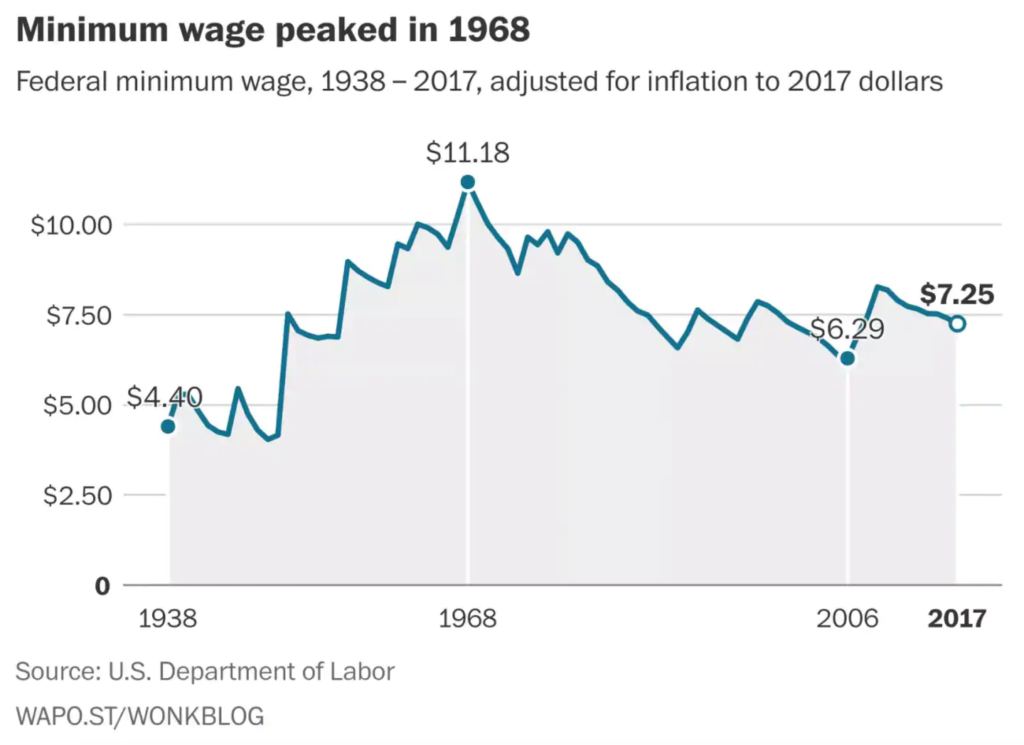
    All workers deserve a living wage and paid sick leave. If the minimum wage kept pace with the 657% rise in inflation & 176% rise in productivity over the past 50 years, it would be $21.72.It peaked in 1968 at $11.18  when a manufacturing job bought you a house for $26,600.00. These workers need a $15.00 min wage now — they needed it years ago.

    Corporate Greed Amidst Crisis

    The Trump administration turned down WHO’s test kits to help his son-in-law Kushner’s company make a profit.

    Wall Street is pressuring healthcare firms to increase prices over the coronavirus crisis. Audio  was obtained of bankers asking drug companies and firms supplying N95 masks & ventilators, to figure out how to profit from the COVID-19 emergency.

    US drugmaker doubled price of potential coronavirus treatment, chloroquine, in January, as the outbreak spread in China.

    While the outbreak spread, Senate Intel chair Richard Burr, sold off up to $1.6 million in stock one week before the market fell. His committee was receiving daily briefings.

    Instead of helping American workers, the system wants to bail out airlines and other industries. Airlines like American blew cash on stock buybacks instead of reserving for a future crisis like working-class Americans are told to do.

    A Second New Deal

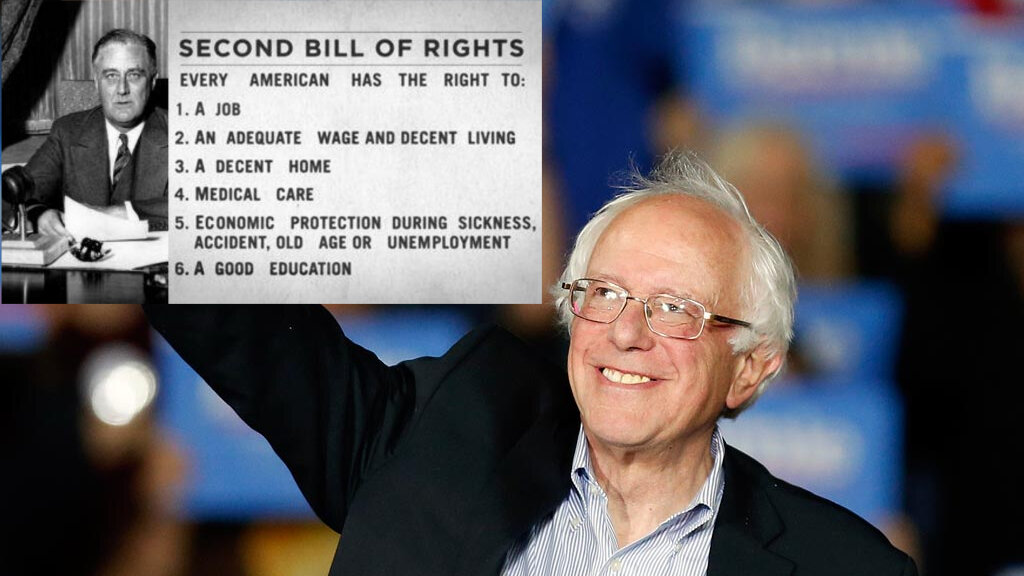
    President Franklin Delano Roosevelt didn’t just lift the United States out of the Depression — he altered the broken economic and political system to prevent it from happening again and championed the working-class. We have dismantled the very protections he set in place so corporations could reap higher profits and the New Deal’s safety net has withered away as a result. America’s individualist culture has failed us in pursuit of higher corporate profit.

    We must demand that Congress pass a bill with paid sick leave, provide emergency unemployment assistance of $2,000 a month per person as Senator Sanders proposed, freeze evictions for all (not just public housing), and classify grocery workers as emergency workers.

    We must enact Medicare for All in the long term so that healthcare — the right to life — is no longer tied to employment and the middle-man profiteering insurance industry which leaves 27 million unable to afford coverage and 500,000 bankrupt. This is a moral awakening and call we must answer.

  • The Productivity-Inflation-Wage Gap and the Effects of a $15.00 Wage Floor

    The Productivity-Inflation-Wage Gap and the Effects of a $15.00 Wage Floor

    If the federal minimum wage had kept up with the 657% increase in inflation and 176% rise in worker productivity  over the past 50 years, it would be $21.72. It peaked in 1968 at $11.18  when the cost of a four-year public university was $329.00, according to National Center for Education Statistics, a manufacturing job bought you a house for $26,600.00, and the cost of living was 657% lower. Net productivity was 77.1% in 1968 while it stood at a record 252.9% in 2018. Economic research has overwhelmingly concluded that a gradual increase to a $15.00 minimum wage would not increase the price level or the unemployment rate. In fact, it would stimulate economic growth through increased consumer demand, business investment and job growth. At a time when income inequality has hit an all time., with 40 million Americans facing hunger, a shocking number of homeless people, and inability of hard-working Americans to achieve socioeconomic advancement in part in the wealthiest country on earth, it’s time to stop the billionaire class from stealing profits from the working-class who has doubled their productivity since the late 1960s. Economists agree that a federal minimum wage increase to $15.00 by 2024 would not cause a rise in the price level or mass job losses. Instead, the spillover effects would cause a strong demand-side stimulus to the economy through an increase in disposable income to the demographic with the highest MPC, and increase middle-wages as well.

    Productivity and the Cost of Living Has Skyrocketed But Wages Have Stagnated

    Today’s $7.25 minimum wage is 29% less their counterparts made 50 years ago adjusted for inflation despite the fact that productivity has doubled since the late 1960s — CEO’s are literally stealing profit from American workers. The United States has one of the lowest minimum wages of any industrialize democracy in the world. The adjusted value of minimum wage peaked in 1968 at $11.18.  According to The Economic Policy Institute , the inflation-adjusted minimum wage has fallen far behind the growth of the economy compared to 50 years ago, when they were virtually equal.

    Economic Inequality

    Income inequality is at an all time high since the Census Bureau began tracking it, yet we perpetuate the “bootstraps” notion that every hard-working person and child has equality of opportunity — an equal chance to succeed in life.  Despite being the wealthiest country on earth, and worker productivity doubling, 12.3% of families continue living in poverty, and 40 million go hungry.

    The richest 10% of U.S. households represented 70% of all U.S. wealth in 2018, and the top 1% hold 42.5% of national wealth, a far greater share than in other OECD countries. In no other industrialized nation does the wealthiest 1% own more than 28% of their country’s wealth.  Economic inequality in the U.S. ranks higher than in any other wealthy, democratic country, and it has the most poor individuals than any other similar developed nations. Inequality has drastically increased since the 1960s were the top 10 percent of families owned around one-third of the national income, and the top 1 percent received less than 10% of all income . The Gini Index shows that the level of inequality in the United States is almost twice as much as in Sweden and a third more than most other European countries.

    Economic inequality has increased since the 1960s due to technology, decline of manufacturing, globalization, and government policies that have not grown the wealth of the middle-class. People without access to the “college wage premium” have seen their earnings decline in this technology age with less manufacturing jobs.  Deindustrialization has decreased these well-paying jobs for many Americans and only low-wage jobs have been growing for those who are non-college educated. The stagnated minimum wage has exacerbated this income inequality as the rich continue to reap a higher share of profits produced by the workers.

    Spillover Benefits of a $15 min wage: Demand-side Economic Growth, Middle-Wage Increases, and Reduced Taxpyaer Spending on Assistance Programs

    According to the Economic Policy Institute, $15 minimum wage by 2024 would result in $121 billion in higher wages for almost 41 million low-wage workers thereby providing a positive multiplier effect to the economy through the raise in disposable income of the demographic with the highest MPC. This demographic would stimulate consumer demand, business activity, and job growth. The increase would be indexed to growth in median wages, thereby securing that the wage floor keeps pace with growth of middle-wage workers in the future. 

    A $15.00 minimum wage would directly affect 28.1 million workers by 2024 and another 11.6 million workers whose wages are just above the new minimum wage through “spillover” effects as employers adjust their scales.

    Liberal economists agree that a  minimum wage raise will stimulate the economy and reduce taxpayer spending on assistance programs.

    The Price Level Would Not Rise

    Two years after Seattle raised its minimum wage to $15.00, a study found no significant evidence of price level increases associated with the minimum wage law.

    The researchers analyzed prices for 106 food articles from six supermarket chain stores in Seattle and in six of the same-chain stores in King County unaffected by the ordinance. The price check occurred at four time points: one month pre, one month post, one year post, and two years post ordinance implementation.

    Effects in Employment: Modest Increases — No Job Loses

    Although some conservatives estimate that raising the federal minimum wage to $15 an hour by 2024 would put 1.3 million Americans out of work (CBO), minimum wage hikes in states and cities in recent years give us actual quantitative data on the effects of wage floor increases

    Economics at UCLA  examined the effect of the statewide minimum wage rise in California from $6.75 in 2006 to $10.50 in 2017 (slated to hit $15 in 2022), and focused on the restaurant industry. They estimated that, “the increments in the minimum wage..were estimated to increase earnings in limited service restaurants slightly more than 10% but reduced employment by about 12%.” And that the rise up to $10.50 by 2017 raised earnings in those restaurants by another 20%, but reduced employment by another 10%..

    Polar opposite to these findings, a U.C. Berkeley study looked at the effects of city-level minimum wage hikes in recent years. It compared the cities of Chicago, Los Angeles, Oakland, San Francisco, San Jose, Seattle and Washington, to economically-comparable nearby ones. The paper found that wages were up while changes to employment were minimal: “We find significantly positive effects on wages and small effects on employment, consistent with many previous studies.”

    Furthermore, a high-profile paper by David Card and Alan Krueger proved what many economists have agreed on — modest increases to wage minimums don’t cause huge job losses. “Many studies have found little or no effect of minimum wages on employment, but many others have found substantial reductions in employment (CBO).”

  • Climate Change Mitigation and The Future of Energy by 2040

    Climate Change Mitigation and The Future of Energy by 2040

    Complete climate change mitigation is an alternative forecast that overlooks carbon-reduction solutions such as sequestration and nanotechnology that will be necessary to meet a 27% increase in global energy demand, provide electricity access in developing nations where 1 billion lack electricity and face barriers to renewable energy attainment. On our current baseline trajectory, renewables will only make up 31% of the energy mix by 2040, as oil and gas will continue to supply over 50% of energy demand. Therefore, it’s imperative that we implement the carbon-reduction technologies often ignored in the hard-line “Green New Deal” conversation, in conjunction with renewable energy in countries without economic and political barriers.

    Effects of a 1.5°C Increase in Global Temperature

    A 1.5°C warming of the globe poses the biggest existential threat facing our growing population today, yet baseline forecasts show despite many “plastic straw bans,” climate protest and global policy inaction — we won’t cause an upheaval of the fossil-fuel energy system to prevent this by 2050. Coastal cities will flood, oceans will acidify, crop yields will plummet and we’ll fail to meet the 70% rise in food demand by 2050. Human activities are estimated to have caused approximately 1.0°C of global warming above pre-industrial levels, and the IPCC forecasts that we will reach the 1.5°C threshold between 2030 and 2052 because we will not meet the net-zero CO2 emissions goal by 2050 by dropping 45% from the 2010 levels by 2030. To achieve this renewable energy would need to supply 70-85% of electricity use by 2050, but we will only reach a 31% of world electricity market share by 2040 despite  400% growth.

    Moreover, our oceans absorb about 30% of CO2 and preventing acidification. When it mixes with water it becomes carbonic acid by releasing H+ ions which makes the ocean increasingly acidic over time. If average emissions continue at the current rate the average pH of the ocean will drop from 8.2 to 7.8 by 2094. This will impact many species of marine life such as pteropods, corals, and other hard-shelled species such as phytoplankton which absorb CO2 and can destroy the food chain if they go extinct. Oceans will eventually become highly acidic and they will be able to hold less CO2 and species will become extinct.

    As the world population reaches 9 billion by 2040, we will face a global energy and climate crisis as global energy demand increases 27%, 25% in developing nations, 1 billion continue to lack electricity access, and renewables compose only 31% of the energy mix. This will occur while fossil fuels will continue to reign  at over 50% of energy demand as we will witness a  41%  increase in gas demand. Oil demand will reach 106 million BPD (IEA), oil consumption 225 quadrillion British thermal units, and natural gas 180 units (EIA). This increased demand coupled with a slow renewable energy implementation will cause an energy conundrum on how to supply it under carbon-dioxide constraints. Per the IEA’s 2019 World Energy Outlook, demand will rise 1.3% each for the next 20 years and will exacerbate greenhouse emission levels and will climb by 6% through 2040. Alternative forecasts based on ambitious climate policy action outlined by Green New Deal style have no current plan going forth the next 20 years. 

    Fossil Fuel Emission Reduction and Carbon Sequestration

    This increased fossil fuel demand in a future world populated by 9 billion where people still lack access implores us to address climate change with action and not become blind-sided by the long-term goal of a renewable energy system transformation; but to instead invest in mitigating CO2-reduction technologies. Carbon-dioxide emissions account for 80% of all emissions, and CO2 is the primary greenhouse gas produced by the burning of fossil fuels that has steadily increased since the late 1950s. but they can be drastically reduced through carbon-capturing technology such as sequestration and nanotechnology. The carbon-dioxide sequestration process injects injects carbon captured from coal plants into the earth. However, this effect is limited since its mainly been used in laboratories in small quantities.

    According to the baseline trends, oil and natural gas will continue supplying over 50% of energy demand in 2040, as global demand grows 27%, while around 1 billion people will lack access to electricity. Oil consumption will reach 225 quadrillion British thermal units in 2040 (up from 200), and natural gas consumption will reach 180 units according to the EIA (up from 130).  The price of crude oil will rise from $52 to $112 per barrel per the Global Energy Institute. Meeting demand in a cost-efficient way is the basis of nanotech applications. Based on the nanotechnology industry’s rapid growth the past two decades and increasing NNI budget ($343.1 million in 2019), the industry will continue to witness steady growth. Oil companies like Shell and BP are working with research institutions to implement these technologies in their production. 

    Energy demand will increase by 27% by 2040 according to the EIA3. Meeting this demand under the world’s shrinking fossil-fuel supply without increasing environmental degradation is a key issue of this century.  Scientists estimate we will have to lower carbon-dioxide emissions by as much as 80% by 2050 4 to prevent a further increase in global temperatures. It is both economically and existentially pivotal to implement renewable energy resources to meet this increased consumption. Achieving this while not limiting development in developing countries creates a conundrum that can be ameliorated by CO2 emission reduction and renewable energy.

    Nanotechnology 

    One solution to meeting this 27% increase in energy demand under CO2 constraints in a baseline 2040 future with only 31% renewables is nanotechnology. Nanotechnology solutions such as nanoparticle enhanced oil recovery, engineered porous minerals, nanotubes, and nano-computerised tomography to explore oil reservoirs can maximize efficiency and lower costs to meet this demand. Production can be increased in an environmentally cleaner way through the employment of nanomaterials for environmental remediation of contaminated sites and groundwater, nanosensors can detect greenhouse gas emission levels, and  carbon capture nanoscale membranes can trap exhaust from energy production sites such as power plants. 

    Growing investment in nanotechnology has already decreased fossil fuel emissions and the NNI budget has increased vastly to $343.1 million in 2019. Oil companies like Shell and BP now implement nanotechnology in their energy production through the use of nanomaterials, carbon-capturing nanomembranes, and nanocatalysts. Oil production has not peaked thanks to EOR through nanotechnology applications. This has all caused the carbon-dioxide emission rates to fall substantially. Big companies like CO2 solutions are influential stakeholders that seek to limit greenhouse gases through carbon-capture technologies that remove exhaust from our power plants.

    Not only does nanotechnology reduce greenhouse gas emissions, but it helps meet the 27% increase in energy demand at a time when peak oil production looms on our horizon. The possibility of peak oil production has frightened many for decades, but an estimate by the EIA believes that reaching peak oil as soon as 2022 is a possibility. When it would occur, production would decline at 3% per year while demand would increase by 3% per year. The Low Oil Resource also projects tight oil production until 2022 then a decline until 2050. Nanotechnology, and its efficient applications in enhanced oil recovery can help prevent situations of low oil supply. Nanoparticles can maximize extraction by reporting what paths oil takes below ground form the injection well to the production well.

    Nanotechnology can prevent this dismal alternative forecast, and help meet the future energy demand reliant on fossil fuels in 2040 in an efficient, cost-effective manner that emits less pollutants, cleans up organic chemicals from groundwater, and VOCs from air through nanomaterial, nanomembranes, and nanocatalyst applications. Developments in nanotechnology in the gas and oil industry lower CO2 emissions through EOR, the production of  nano-tubesnano-sensors for air pollution monitoring and carbon-capture nanoscale membranes, thereby reducing the negative environmental impact of fossil fuels. Fossil fuel-based energy will be produced more efficiently due to nano fluids and other nanotechnology applications in the enhaced oil recovery process. The Department of Energy, oil industry and energy consumers should continue advocating for these carbon-dioxide reducing technologies.

    Renewables

     By 2040 renewables will have the fastest growth rate, they have increased 67 percent from 2000 to 20165, only supply 31% of energy6. The biggest source will be biomass — a health hazard used in the developing world. Wind (8% a year), solar, and biofuels will grow rapidly but will only be 15% at most of energy. While we will fail to meet net-zero emissions by 2050 and likely won’t implement an energy system based on 70-85% renewables, that doesn’t mean we shouldn’t try to surpass the 31% forecast and reduce emissions through the employment of hydro fuel cell, solar, wind, and bio-energy in addition to a smart distributed energy grid.

     Renewable energy technologies such as solar energy, wind energy, hydrogen fuel cell, bioenergy from algae only make up 31% of all energy in our baseline 2040 future. Although they have grown at an incremental but slow rate they have been impactful on consumers, transportation, and the economy. Low-carbon sources led by solar PV supply over half of the growth. Oil flattened out in the past decade, and coal has fallen as expected by the IEA’s 2019 WEO. Solar PV energy leads renewable energy electricity generation. Growing investment in nanotechnology has decreased fossil fuel emissions and the NNI budget has increased vastly from the $343.1 million NNI budget from two decades ago. Oil companies like Shell and BP now implement nanotechnology in their energy production through the use of nanomaterials, carbon-capturing nanomembranes, and nanocatalysts. Oil production has not peaked thanks to EOR through nanotechnology applications. This has all caused the carbon-dioxide emission rates to fall substantially. Big companies like CO2 solutions are influential stakeholders that seek to limit greenhouse gases through carbon-capture technologies that remove exhaust from our power plants.

    The Smart Grid

     An opportunity for the future of the electricity grid is the smart grid — where utilities can better communicate with smart homes and consumers and measure homes’ electricity consumption more frequently to lower energy consumption and thereby emissions. Initially, the grid was designed in for utilities to deliver electricity to user homes on a small scale, then billed once a month but energy demand has increased exponentially since then. The one-way communication model of this initial system makes it difficult to meet increasing energy demand. Whereas smart grids enable consumers to manage electricity use to more evenly distribute electricity use. reduce power outages caused by weather and when demand outpaces supply. This is achieved by measuring energy fluctuations using smart sensors, then by rerouting power delivery. Ultimately this aids end-users through lowered production-costs and subsequently, smaller bills. This smart grid innovation is an economic benefit which helps end-user experiences.

    The Future of Solar Energy

    Solar energy is another big player in the future renewable energy industry with strong potential to replace a large percentage of fossil fuel’s market. Moreover, distributed energy has the most potential to increase through on-site solar installations of solar crystalline photovoltaics panels. They are the most efficient and deliver power to end-users. 

    Enough energy from the sun hits the earth every hour to power the earth for an entire year. The photons from the light strike the cell in the panel’s energy field, free electrons, and the electrons create electric current which then travels through an electrical circuit powering electrical devices or sending electricity to the grid. PV devices can power small electronics, homes, and businesses. They’re also the most cost-efficient for setting up a large-scale system.

    Thin film solar panels are also an innovative option for distributed power generation but they’re less efficient (11-13%) than PV which has 15-20% efficiency. They’re made with solar cells containing light-absorbing layers 350 times smaller than PV panels and thereby have less carbon offset in their production. Passive solar homes are also a good distributed power generation option but are more costly to be implemented on a large consumer scale. It’s easier to install PV panels than to redesign people’s entire homes.

    Wind Energy

    Wind power is the fastest growing, most efficient, cost-effective, and consumer-affordable energy source. For this reason, it  has the potential to expand its market share across the globe to developing nations. It has grown around 26% over the past 18 years and forecasts predict constant large-scale growth. Wind energy industry saw a record 8% US growth in 2018, and it is predicted to employ around 1.5 million people by 2020. Surpassing the estimate of 31% renewable energy to achieve a substantial cut in CO2 emissions, provide affordable energy world wide, and meet increasing demand of a world population over 9 billion will only be made possible through offshore and on-shore energy farms.

    Wind energy is the most efficient form of renewable energy, producing  1,164% efficiency in comparison to geothermal’s 514%, hydropower’s 317%, nuclear’s 290%, and solar’s 207%7. It is created by harnessing wind to generate electricity. Wind turbines capture the wind’s kinetic energy and rotate it turning it to mechanical energy. The rotation turns an internal shaft on a gearbox and spins a generator that produces electricity.

    Efficiency is calculated by the cost of fuel, production, and dealing with environmental damage. The 1,164% figure represents the percentage of energy input retained when converting fuel to electricity. Moreover, it is the least expensive renewable energy source to produce, with an average cost of $0.06 per kWh while other technologies such as solar panels cost  $0.10 per kWh at the lowest8.

     By 2050, 25-30 percent10 of global power could come from harnessing the wind (up from 3%11 in 2016.) This would help meet the 28% increase in energy consumption under CO2 emission constraints. Implementing this level of energy involves overcoming problems hindering energy deployment such as cost, resource availability, and policy decisions such as tax credits.

    Wind energy alone generated over $143 billion in private investment over the last decade. It produced $7.3 billion in public health benefits by cutting pollutants. This while only being the third most popular at only 18% of renewable energy consumption out of the 10% of total US renewable energy consumption. Overall, renewable energy is the fastest-growing energy source in the United States, increasing 67 percent from 2000 to 2016. They made up almost 15 percent of net U.S. electricity generation in 2016, with the majority coming from hydropower (6.5 percent) and wind power (5.6 percent). Renewables made up 24 percent of global electricity generation in 2014. That’s expected to rise to 31 percent by 204015. The most efficient increase will come from wind and hydropower.

    The wind industry has grown around 26 percent per year over the past 18 year. This is because wind power is the least-cost option for adding power capacity to the grid. Moreover, this industry currently employs around 600,00017. That figure could rise to around 1.5 million by 2020 and exceed 2 million jobs by 2030.

    Furthermore, two federal tax credits encourage renewable energy projects: the production tax credit (PTC) and the investment tax credit (ITC). The former, is available to renewable energy technologies, and wind, geothermal,  and closed-loop biomass, receive a 2.3 ¢/kWh ($23/MWh) credit for all electricity generated during the first 10 years of operation20. Wind, with an average total system cost of $64/MWh, the PTC yields a 34 percent cost reduction. Overall, the PTC alone drives about $15 billion per year in private investment in the U.S.

    A two megawatt wind turbine in a year can sometimes only produce 7,884 MW out of the theoretical maximum of 17,520 MW-hours due to wind strength inconsistency. This results in lost output, and only a 45% capacity factor. Offshore wind farms provide stronger, steadier winds and output. Moreover, the Department of Energy found the U.S. could develop a total of 86 GW of offshore wind projects by 2050. The National Renewable Energy Laboratory estimates that the technical resource potential for U.S. offshore wind is more than 2,000 gigawatts of capacity. A single offshore wind turbine of 3.6 MW at 90% capacity can power 2,584 average U.S. homes annually.

    Evidently, offshore wind farms produce twice as much energy as land-based wind farms while maintaining the same advantages. They deliver large-scale clean energy to fulfill the future 28% increase in energy demand and would rapidly exceed the 25% wind energy fraction of total energy consumption by 2050.  The wind sector has grown 25% per year over the past 18 years, employs 600,000 Americans, yields 1,164% efficiency, has the lowest average cost of $0.06 per kWh out of all renewable energy sources. It has produced $143 billion in private investment will continue to yield large profitability with the help of PTC and ITC incentives. Vind hopes to power the future in a sustainable and efficient way.

    The Future of Vehicles

    Hydrofuel cell cars are CO2 emission free, but they are pose an initial cost-efficiency challenge.Some estimate that hydrogen costs $18/million BTU while a fossil fuel like natural gas costs $6/million BTU. From the cleaner electrolysis process with electricity at 5 cents/kWh it will cost $28/million BTU — 1.5 times higher than producing it from natural gas.Additionally, the cost of building this new energy infrastructure for hydrogen cars would be a large investment.

    As of 2018, only 2.1% of vehicles sold were electric vehicles. While that is a record number signaling growth, it’s only a small percentage of all vehicles sold. The transition to electric vehicles will be a slow one, the largest forecasts expect electric vehicles to take up 10% of total new vehicle sales by 2025. Electricity and hydrogen powered cars are likely to see growth when manufacturing prices fall and more consumers can afford the new technology. The process of manufacturing is already more efficient since electric motors don’t require the same team of workers to produce different capacity engines (V8, etc.) Manufacturers also regain 1/3rd of the vehicle chassis by replacing technical combustion engines with electric motors.

    The Future of Biofuel

    By 2030, bio energy production will rise and we will move towards a slightly more sustainable economy with a wider use of renewable resources. The transition to a bio-based economy will be powered by cellulosic ethanol and algae-based bio energy, not corn ethanol. Biofuels can be used to build chemicals, materials, energy, and both internal combustion engines. Bio fuels have met some resistance as some argue that they are more costly to produce and less efficient by pointing to the net negative energy output. In reality, all fuels have a negative output — the energy in the oil pre-production isn’t counted.

    Companies like Vertigro and Wageningen UR are already building towards this sustainable future of energy by producing algae-based bio-energy. Vertigro seeks to produce over 20,000 gallons of bio-fuel on one acre. They believe with the amount of farm space of 1/10 the size of New Mexico we could produce enough fuel to fill the U.S.’ need for oil.

    Bio industrialism will also fuel this transition by innovating while lowering manufacturing costs and increasing output to build a more sustainable future. Wageningen believes the transition to a bio-energy based future will be built by the green raw materials, emission free production processes and bio-based products they produce.

    Carbon-pricing Schemes

    Over 40 countries have put a price on carbon, through direct taxes on fossil fuels or cap-and-trade programs. In Britain, coal use plummeted after the introduction of a carbon tax in 2013. Carbon pricing schemes are government policies designed to put a price on the carbon for the negative external costs produced by carbon emissions in order to reduce them. They come in two forms — an ETS ‘cap-and-trade system’ and a carbon tax. An ETS caps the total amount of greenhouse gas emissions and lets industries with low emissions sell their extra allowances to those with larger emissions. Supply and demand is created in this way and subsequently a market price for greenhouse gas emissions. We should push for carbon taxes which set a direct negative externality tax on greenhouse gas emissions for costs paid by the public through crop or health damage. 

    Summary

     Renewable energy technologies such as solar energy, wind energy, hydrogen fuel cell, bioenergy from algae only make up 31% of all energy in our baseline 2040 future, but carbon-sequestering nanotechnology has shown promising results in reducing CO2 emissions in a developing world economy of increasing fossil fuel demand. We currently consume over 11 billion tonnes of oil yearly. While oil reserves are used up at a rate of over 4 billion tonnes a year, at this rate our oil deposits will run out within about the next 53 years. Energy demand (calculated by through GDP and population growth), will grow by 28% by 2040 according to the EIA. If we do not implement renewable energy technologies and increase efficiency our consumption of energy (oil) will exceed production which peaked in the 1980s. 

    The total carbon dioxide emissions from fossil fuels increased by 1.6% in 2017 to 36.2 gigatonnes CO2. CO2 is the primary greenhouse gas produced by the burning of coal and other fossil fuels (oil and natural gas). Atmospheric CO2 levels have steadily increased since the late 1950s.This impacts climate change as elevated levels of heat-trapping CO2 in the atmosphere create what is known as a greenhouse effect. Thereby, trapping heat from escaping the earth. In turn, ocean temperature rises and causes climate change. About 40% of the CO2 emissions in the U.S. come from coal alone. We can’t simply eradicate carbon – (80% of CO2 emissions) – because it’s our main energy production source, but rather reduce emissions through carbon-capture technology such as sequestration.

    It’s an ambitious myth that climate change will be mitigated below the 1.5 C level by 2050 through a 80% CO2 reduction. Forecasts estimate that we will reach at most 31% renewable energy not the 70-85% goal. Over 50% of the energy mix will continue to be dominated by oil and gas as energy demand rises 27%, and 45% in developing countries with 1 billion people who will still lack electricity access. Methods to reduce and sequester CO2 emissions from fossil fuels as their demand rises with the growing 9 billion future population must be implemented. Nanotechnology can aid in this goal along with carbon sequestration to prevent energy supply shortages. Furthermore, we must heavily invest in the most powerful renewable energy in countries without barriers to access. Wind energy is the most efficient form,  producing 1,164% efficiency, it generates the most kWh at a low cost of production. Greenhouse gas emission reducing technology in conjunction with solar energy, electric and hydrogen fuel cell vehicles we can surpass this 31% figure to prevent increased global temperatures due to a 27% increase in energy demand, and can help meet the demand.We only have a finite supply of fossil fuels that is increasingly become limited in supply as the world population reaches over 9.8 billion by 2050. Fueling the future is a question of both meeting demand and meeting it sustainably. 

    Per baseline estimates, if we don’t implement these solutions, by 2040 the world will face an energy and global climate crisis as the 9 billion world population has increased energy demand by 27%, 45% in developing nations, 1 billion continue to lack electricity access and renewables have experienced slow growth — only making up 31% of the energy mix. Oil demand will reach 106 million BPD as projected by the IEA. Oil consumption will reach 225 quadrillion British thermal units, and natural gas 180 units (EIA). Despite a rise in renewable energy, fossil fuels will continue to supply over 50% of energy demand. The increased demand coupled with a slow renewable energy implementation has caused an energy conundrum on how to supply it under carbon-dioxide constraints. We will fulfill the IEA’s 2019 World Energy Outlook, and demand will rise 1.3% each of the next 20 years and exacerbated greenhouse emission levels. Due to this, carbon dioxide emissions will climb by 6% through 2040 and we will surpass the 1.5C constraint by 2050.

  • Bernie Beats Trump: How The Most Electable Candidate Fights For You

    Bernie Beats Trump: How The Most Electable Candidate Fights For You

    Presidential candidate Bernie Sanders’ surging lead in the polls, leading donations with a record 4 million small donors, and majority-support for his policies across demographics make it clear he’s not only the true populist in the race, but the most electable once-in-a-lifetime candidate. Faux-populism won in 2016, and centrism’s failure made it clear that ‘any blue’ just won’t do. At a pivotal historical time with climate catastrophe only 12 years away, healthcare the number one cause of bankruptcy in the wealthiest country on earth (with 78% already insured), the oligarchy’s stranglehold on the working-class now stronger than ever, stagnating wages that haven’t kept up with inflation, a human rights crisis in the Middle-East, and a student debt crisis that stagnates economic growth, only a progressive agenda can address these key issues. America deserves an uncompromised leader that has been fighting for economic, environmental, and social justice for the past 55 years. The Democratic party must return to the a new New Deal. Bernie Sanders knows what Martin Luther King Jr. knew — there can be no equality without economic justice.

    As Bernie said, “It’s time to make our government work for us and not just the 1%.” Americans deserve a true leader who has fought for policies even when they were unpopular. Regardless of political party Bernie fights for everyone. He has never been compromised by accepting billionaire PAC donors like other candidates such as Warren, he has not backpedaled on policies he’s supported his entire life like Medicare for All like Warren has, he has never supported the military industrial complex by voting to increase the budget three times like Warren, Bernie doesn’t represent corporate criminals and fail to prosecute them for mortgage fraud like Harris. Bernie is not the establishment, Bernie is for the people.


    Bernie doesn’t want an America that cuts taxes for the rich to fund billion dollar wars, leaves veterans on the streets, people dying bankrupt, and then proposes $64 billion cuts to Social Security Disability Insurance “balance the budget.” Bernie doesn’t want an America in which people can’t afford insulin, in which the minimum wage hasn’t kept pace with inflation and billionaires rob hard-working Americans

    Bernie is the FDR Democrat our country desperately needs at a time of late-stage capitalism were people flock online to crowdfund hospital bills and work two jobs because the minimum wage hasn’t kept pace with inflation.

    The senator believes in a government run by the people, by principles of economic justice seen in democracies like Canada, Switzerland, and the UK that provide their tax-paying citizens with human rights such as healthcare and education without going bankrupt. Bernie is the most honest, once-in-a-lifetime candidate that will not stand by while 3 people own more wealth than the bottom half of America, while 20% of children live in poverty, 40 million go hungry, and people can’t afford healthcare. Bernie will lower drug prescriptions, enact medicare for all, livable wages, rebuild crumbling infrastructure, eliminate college debt, rebuild social security, deliver environmental justice, rebuild unions, stimulate the economy through debt elimination.

    Bernie’s Surge in The Polls

    After Elizabeth Warren’s 14 point plummet in the polls since the last Quinnipiac poll from a month ago, after her the facade for her universal healthcare support fell and Kamala’s crumbling campaign resulting in lay-offs, Democratic elites and the MSM are desperately propping up establishment candidates offering no change from the oligarchy’s status-quo. Barack Obama even allegedly stated that he would “speak up to stop” Bernie This bias, if anything, is an endorsement of Sanders’ integrity, populism, and policies that have the establishment so shaken up. And according to recent polls in key democratic states, the people are waking up and they want change.

    The most recent polls show Bernie handidly beating Trump 48-43%, winning all key states Democrats need to win — New Hampshire at 26%, tying with Biden at 22% in Iowa. And in an early-state voter poll (Iowa, NH, NV, and SC), Sanders has surged to second place at 23% (+5) while Biden has fallen -3%. Furthermore, Bernie has gained 9 points in the pivotal primary and caucus states. In a general election head to head: Sanders wins Michigan 57% (+14) to Trump 43%, New Hampshire 52-48%.

    This should come as no surprise. Polls during the last election’s primary season consistently showed Sanders handily defeating Trump by 10 points or more, while Clinton led him by only a few points within the margin of error. This is easy to fathom considering Trump secured the nomination as Hillary lost the three historically blue states that Bernie did well in during the primaries. Sanders beat Clinton in Wisconsin and Michigan. And the DNC chosen candidate lost Pennsylvania.  Narrow margins of eight-tenths, three-tenths, and 1.2% in these three Rust Belt states where Sanders’ message resonated, handed the election to Trump.

    Moderates and Democrats

    Senator Sanders also performed well among moderates (Sanders leads 56-28%), and he even has a 78% favorability rating among Democrats.

    Bernie Wins Among Minority, Female, and Millenial Support

    The American people from all backgrounds have overwhelmingly spoken in favor of Bernie Sanders. According to a Harvard-Harris poll, 58% of non-white voters; that is, 73% among African-Americans, 68% among Hispanics, 62% among Asian-Americans, 56% among women, 62% among 18-34-year-olds and 78% among Democrats. In a general head-to-head, Bernie leads among African American voters, receiving 83% support compared to only 5% for Trump.

    Bernie Sanders also dominates with the most powerful voting bloc — millennials. In general election polls, Sanders wins with younger voters aged 18-29, leading 70-21%. He also beats Trump with voters age 30-49 (48-43%), while Trump wins voters aged 50+ (Trump leads 53% to 39%). Sanders even leads among men 51-41%), non-college educated voters (Sanders leads 49-42%), and Independent voters Sanders leads 56-28%.”

    Bernie Wins Among Independents

    A widespread concern among Sanders skeptics is how he will fare among independent voters but Sanders leads 56-28% among Independents, and he fares well among the rust-belt Obama coalition which crossed over for Trump in 2016.

    More Donors Than Trump and Any Other Candidate

    Bernie has more donors than Trump and any other candidate. He has the biggest grassroots support, from nurses to military members But the media tells us that raising $5.9 million in one day is no big deal. That $10 million in a week means he should drop out.

    Bernie Draws Back the Rust-Belt Obama Coalition Democrats Lost in 2016

    The working-class coalition transcends political party. Bernie’s agenda fights for every American regardless of their class, party, or race and people are starting to see that. Bernie will not only win the primary with his surging early-voting state polls, but he will win the general election with his fervent support among Independents, and favorability among Republicans.

    Bernie Will Draw Support From Republican Voters in the General

    Fox News viewers are more likely to support Bernie than those who watch MSNBC. The Red-baiting conspiracy channel full of biased hit-pieces that pays propaganda artists to provide insightful commentary such as,” I don’t know what it is about Bernie, he just makes my skin crawl.” Bernie won every county in West Virginia in 2016. Sanders has been an effective, mediating, bipartisan voice, reaching across the aisle in CNN town halls and making Trump voters ‘feel the bern.’ Time and time again, his centered economic message has reached coal country effectively with none of the dripping ‘liberal east coast elite’ condescension.  In a West-Virginia townhall a county of Trump voters thanked Bernie and clapped for raising taxes, Medicare for all, and free college. His working-class message would’ve obviously resonated with disgruntled Trump voters on it’s own, but his ability to effectively communicate across the aisle would’ve done numbers.

    Centrism Doesn’t Work. Bernie is The Only True New Deal Democrat. 

    Neo-liberalism resulted in 910 total seats lost under 8 years of a Democratic White House. It handed over rampant legislative control to the Tsar in Chief for two years. The Democratic party has moved righ of center, not left. While candidates like Warren (“capitalist at heart”) try to negotiate with a broken system, Bernie is trying rebuild it in favor of working-class Americans. While Democrats and Republicans practice bipartisanship in bailing out Wall St., passing corporate tax cuts, and funding the military industrial complex, Bernie wants a return it to New Deal style politics. A return to an America that works for all

    Neo-liberalism lost in 2016 after years of democratic establishment politics failed to deliver hope and change. Working-class whites who previously voted for Obama were fed up with establishment politics and an unresponsive plutocracy so they voted for the only general election candidate who wasn’t bought by Wall Street and promised to remedy working-class struggles. Who else had an populist, working-class message and wasn’t lying about it? Sanders who made economic inequality the platform of his campaign would have obliterated Trump. But he won, and the country lost thanks to democrat hubris.

    Left-wing policies are were the numbers are at.Hillary failed to draw Obama voters, and experienced the downfalls of low-voter turnout that come with a centrist, establishment, purely opposition campaign. She won 55% of the vote compared to Obama’s 69% in 2012, seeing a decrease in support from black, Latino,  young voters and non-college whites. She lost the rust-belt Bernie had won the primary in, lost the millenial vote Bernie gained more votes. Both Trump and her combined, and garnered only 28% of the non-college white vote where Obama had previously won 40% of in 2012.

    The first female to win the nomination for president didn’t even gain 50% support from white women against the man with sexual assault allegations and and the Access Hollywood tape. Compared to Obama’s 93% of the black vote, Hillary garnered 88% of the black vote against a candidate who was sued twice by the DOJ for not renting to African Americans. And 65% Latinos vs 71% for Obama against a candidate who called them rapists. Most damaging, 54% millennial support, compared to obama’s 60%. Guess who draws millennials? Bernie Sanders and his progressive policies. In fact, more young people voted for Sanders than Clinton and Trump combined.

    Center-left corporatist politics no longer work, It contends that to gain back a disenchanted voting base you have to further alienate them by fully and openly embracing neo-conservatism just to pander to right-wingers who would never vote blue in a million years. The solution to a low-voter turnout epidemic in the 2016 election is to adopt more of the things that made them stay home, as part of your campaign.  How is it possible that the party of Medicare cuts won the largest majority in Congress and state legislatures since 1928 when the majority of Americans support progressive policies?

    It’s simple, Democrats have abandoned the illusion of being the party of progress in favor of big corporate interests.

    Medicare for All Isn’t Radical, $6.4 trillion Spent On Wars Since 2001 Is. The Majority of Americans Support Bernie’s Policies

    Sanders was voted the most popular politician in America per a Fox News poll.  There’s a reason he has a higher approval rating than any Democrat or Republican on the hill. It’s not just his unwavering morals, pseudonym as the “Amendment King,” or corporate-interest free record. It’s obfuscated fact that the majority of the country supports progressive policies and the majority of the electorate identifies as independents.

    Fifty-eight percent  of Americans support single-payer, 88% oppose cuts to Social Security, voters in red states want Medicaid expanded, 68% think the wealthy pay too little taxes, 64% support regulating greenhouse gas emissions,58%  support breaking up big banks, 63% support raising the minimum wage to $15.00, 53% support labor union law, 64% think corporations don’t pay their fair share.

    John F. Kennedy once advocated for Medicare For All, Eisenhower’s top tax bracket was 90%. Back when the middle-class flourished because of their policies, no one ever called them radical.

    But How Will We Pay For It?

    No one ever asked how we would pay for $6.4 trillion on wars in the Middle-East and Asia since 2001, but here we are. We also don’t need a candidate who talks about “expanding” the ACA while people die rationing insulin and not affording healthcare. The ACA raised premiums and deductibles nearly 300%, should we expand them to 600%?

    In the world-power that is the United States, medical expenses have long been the number one cause of bankruptcy, with 78% of filers already having health-insurance. It should be considered a serious issue when inhabitants of the wealthiest country have to choose between death or bankruptcy, food or medicine. The healthcare industry has turned into a for-profit business, which despite having skyrocketing costs, leave us at 33rd place in life expectancy and outcomes that are not notably superior. To put it simply, Americans are paying more tax money per capita and getting less. Whether one thinks healthcare is a right or not, you should favor the most fiscally responsible choice, a choice which happens to save millions of Americans lives. And that is the core of a single-payer system.

    We currently spend $20 trillion a year; $15 trillion through insurance premiums and $5 trillion through co-pays. With the government spending an amount per capita far more than any other nations at $3.2 trillion a year, 17% of our GDP, $10,000 per person. That’s double what the United Kingdom spends, and more than Germany and Canada, for a whole lot of medically induced bankruptcy here. Contrary to popular American-exceptionalist-belief, this does not give us better healthcare outcomes and we rank last among 11 countries according to a Commonwealth Fund report.

    Who’s to blame for this cost-ineffective system bringing us subpar care? The answer is – the for-profit industry sustained by insurance companies. We’ve created a broken system where the goal is maximizing profit. This inevitably leads to over-treatment, inflated prescription drug prices, and 30 million drastically uninsured. We’re quite literally profiting off illness. Why are we okay with all of this? Why are we okay with investors and CEO’s making billions off the most vulnerable in our society while they suffer? It’s not cost-effective, it’s not outcome effective. The only people this crony system benefits is insurance and pharmaceutical industry CEO’s. Not the people providing healthcare, not the people receiving it.

    We currently spend $20 trillion in healthcare costs – $6 trillion of that stemming from insurance costs, and $3.1 trillion in tax subsidies to employers. By eliminating the useless middleman insurance companies are through single-payer, we save $9 trillion total from that annual $20 trillion budget. There’s $11 trillion of costs left to take up that can then be covered by a 6.2% income-based premium from employers, and 2.2% income surtax from households. If we look to Bernie Sander’s plan, families of four making under $28,800 would see no such increase. So yes, taxes would increase for everyone else, but by paying a relatively small amount more in taxes for full-coverage healthcare, we’re all saving the enormous amount of $20 trillion we would otherwise pay. By enacting such a tax increase and eliminating the nonsensical insurance industry from the picture, Americans would save $9 trillion a year they would otherwise spend for premiums that don’t cover a papercut.

    The economic benefits are endless. An average middle-class family of four, making $50,000 a year, would go from paying $5,600 a year for healthcare to $466 under a 2.2% tax hike. Does that sound like socialism? Moreover, those who would normally be covered by employer-sponsored healthcare would see a salary increase because they’d no longer have it deducted from their paycheck.  Small businesses wouldn’t be forced to spend time and money negotiating coverage with insurance companies thus increasing productivity. It’s preventative – saving people from having to go through extended hospital visits and chronic illness treatments. Single payer would also slash costs imposed on hospitals by the industry, to the tune of $400 billion a year. Which is already “enough to cover all the uninsured.

    Furthermore, all the problems under our current system, the shortcomings of the Affordable Care Act, bureaucratic nightmares, disappear. All medically necessary services are covered: doctor, hospital, preventive, emergency, long care, psychological, dental, vision, prescription drugs. People can choose their own provider. Priorities are no longer distorted and better quality of healthcare is provided no matter how much money you make. People would no longer be overtreated because they can pay more.In addition, single payer would reduce incentives to over treat and lower drug prices according to the PNHP.

    Healthcare is a human need, not a luxury. It’s utterly despicable and nonsensical for Americans to pay more per capita than any other nation for people to be led to medically induced bankruptcy, 27 million to be uninsured, 30 million underinsured, and to rank 33rd in life expectancy. To pay more and get less because the health insurance industry must butt in the middle of it so billionaires can line their pockets.

    Warren and the Establishment Candidates Fall Short of Change

    The mark of a true leader is being on the frontline of every progressive socioeconomic issue for the past 55 years like Bernie Sanders has, not just when it’s politically convenient to do so. Bernie was fighting for the same issues since the 1960s before he even entered Congress, when he was arrested protesting desegregation. He’d been the only Independent in Congress for decades when he had nothing to gain. Unlike Warren, Bernie was not a Republican during the Reagan administration, he was fighting for economic justice. While Harvard was promoting Warren as their “first Native American professor,” Bernie was still championing universal healthcare. While Warren — who has backtracked on Medicare for All-– was appropriating Native American racial identity for career advancement, Bernie was fighting for the environment. If anything, she should be Treasury Secretary not President.

    Warren does not support Medicare for All. She is a faux progressive riding on the movement brought into the mainstream by Bernie in 2016. Warren will not deliver Medicare for All and prevent 500,000 from going bankrupt in 2020 from medical bills. She retracted her support and instead advocated for a “public option,” introduced at the end of her 3rd year, as a 10-year-plan. While Bernie vows to introduce the bill he wrote in his first week in office.

    Warren can not be trusted to upend a fundamentally broken economic system rampant with wealth-inequality when she has a history of accepting billionaires’ donations. She has signaled to the oligarchy’s party insiders her deference and loyalty. Bernie Sanders has never accepted billionaire donations. Senator Sanders plans to make them pay their fair share of taxes instead of paying $0 a year like Amazon.

    Unlike Warren, Bernie didn’t vote to fund Trump’s military industrial complex three times — raising the latest defense fund budget to $700 billion.

    Unlike Kamala Harris, he’s not a mortgage fraud criminal defender, big pharma gatekeeper, or a plutocrats selling the middle-class increased domestic surveillance powers, voting for $716 billion military industrial complex spending bill and deregulating Wall Street. Bernie is a candidate whose agenda stands for issues the majority of Americans support – single-payer, higher wages, access to higher education, criminal justice reform, green energy.

    Why Bernie?

    Bernie Sanders presidency means Medicare for All, the fiscally responsible $2-trillion-saving plan which is cheaper than premiums. (Because despite paying twice as much per capita as other countries in healthcare, leaves 30 million uninsured.) It means standing for economic justice – a higher minimum wage closer to inflation, closing corporate tax loopholes that leave companies like Amazon paying $0 in taxes, rebuilding labor unions which brought us the weekend and minimum wages, and it means environmental protection..

    It means ending Citizens United, fighting against voter suppression and gerrymandering, and criminal justice reform in a country that spends $80 billion a year imprisoning more people than any other country. It means aggressively combating impending climate change destruction with a Green New Deal.

    It means boosting the economy by supporting the middle-class who has the highest MPC, through $2-trillion-saving healthcare, tuition-free public college, $1.5 trillion student loan debt elimination economists approve of, expansion of social security, and green energy jobs. It means supporting foreign policy based on diplomacy and human rights. (Bernie Sanders has even called for cutting aid to Israel and redirecting it to provide humanitarian assistance to Gaza.)

    A vote for Bernie Sanders is a once-in-a-lifetime vote for economic, social, racial, and environmental justice. A one in a lifetime chance to return to the America that worked for the middle-class. Bernie is the foreign policy, environmental, and immigration candidate. He’s the candidate for all of America, not the corporate plutocrat elite compromised by special interests. He’s the most electable candidate that can beat corrupt, con-man, child-caging, Social Security-defunding, corporate welfare enacting Trump. He is unmatched because he’s driven by changing America so the working-class can rule, not by becoming presidents like other candidates.

    At a time when centrism is no longer a winning strategy, this populist, modern day FDR will not beat Trump, but he will return the Democratic party to the left, and deliver a new deal. Bernie Sanders will does not play with the broken system, he plans to repair it in favor of the working class. The Amendment King, son of working-class migrants, built the most progressive DNC platform, brought Medicare for All into the mainstream arena, got Amazon workers $15 an hour.  Imagine what he can accomplish in office. He has had nothing to gain being by being on the right side of history for the past 55 years. We have every human right to gain by being on the right side of history in 2020.

    The time has come to fulfill and expand upon FDR’s vision that he laid out 75 years ago. These are not radical ideas. They’re supported by the majority of Americans. Working together, we can and must achieve economic, social, racial, political and environmental justice for all.

  • The U.S.-Created Central American Asylum Human Rights Crisis

    The U.S.-Created Central American Asylum Human Rights Crisis

    Despite previously accepting the most refugees globally, the U.S. has a dark history of denying asylum to those fleeing human rights abuses — from the Jewish refugees in the 1930s, to the Haitians during the Duvalier dictatorship, and Salvadorans fleeing political violence in the 1980s. Many times these crises have been caused by U.S.-led regime changes that have bolstered dictators and left behind violent instability. This year, the Trump administration  has blocked asylum for Latin Americans fleeing persecution at the southern border. Previously stating these children “are not innocent.” With his interim order, ‘life-or-death’ migrants fleeing gang violence in their home countries (the effect of the United States’ disastrous, interventionist foreign policy) present themselves at a point of entry and are denied. Those that aren’t detained for prolonged periods of time in cramped camps are sent back to often face the death they escaped from. Yet the UN has found that in 58% of cases children from El Salvador, Guatemala, and Honduras, warrant international protection as refugees.

    The United States once stood as the beacon of freedom and equal opportunity, but now stands as the place which sends 5 year old migrant children to court alone with no lawyer, and runs for-profit camps with human rights violations. During 2018, we fell second to Canada for the first time as 22,500 refugees settled in the U.S., in 2017 we granted asylum to 26,568 individuals.

    Central American Migrants are Not Economic Migrants but Life-or-Death Migrants

    Guatemala, El Salvador, and Honduras are experiencing record levels of violence. With El Salvador and Honduras ranking among the top five most violent countries in the world. The UN Refugee Agency reports that the violence and persecution faced by this Latin triangle is so extreme children would rather embark on a treacherous long journey to the U.S.  Subsequently, the total number of migrants apprehended at the border is on the rise again after reaching near its lowest level since the ‘70s. UNHCR  documented a 1,185% increase in the number of asylum seekers from Guatemala, El Salvador, and Honduras, in Mexico, Panama, Nicaragua, Costa Rica and Belize,from 2008- 2014. The U.S. has received 85% of the total new applications from these three countries in 2012 Additionally, the number of unaccompanied children, has doubled annually since 2011. The U.S. will reach an estimated 60,000 child asylum seekers this year.

    https://web.archive.org/web/20260210203804if_/https://player.vimeo.com/video/281315900

    Migrant Children and Families Warrant International Protection per Asylum Law

    The 120 page UN report found that 58% of (the 404) children interviewed were forcibly displaced by harms warranting international protection. A statistically significant finding. 72% of those children from El Salvador “raised potential international protection needs.” With 66% citing organized violence as reason for migrating. They witnessed “extortion..murders..threats to themselves and their families, friends and neighbors.”

    Of the children from Guatemala, 38% raised international protection concerns, 64% for Mexico, and 57% of Honduran children “raised potential international protection concerns.”

    The Courts Discriminate Against Asylum Seekers and Deport Them to Their Deaths

    According to U.S. asylum law, protection is issued to those who can prove persecution “on account of race, religion, nationality, membership in a particular social group, or political opinion.” However, the generalized violence targeted at women and children doesn’t easily fit into one of these groups. Thus, U.S. immigration courts grant asylym to those mirgants who  demonstrate “a well-founded fear of persecution”, or who qualify for protection under the UN Convention Against Torture.

    Nonetheless, the U.S. doesn’t apply the law free of racial bias, much less with this administration’s restrictions on asylum for vulnerable children and families.  Asylum is granted in over 75% of the time in NY while only 10% in Atlanta. Life and death decisions are made arbitrarily. A 2017 report found that the asylum law isn’t applied justly — two Honduran women fled for their childrens’ livelihood, and yet only one was granted asylum while the other deported. In fact, we deport victims of terror — the U.S. government denied a literal slave asylum in the U.S. because she provided “material support” to a terrorist organization – as its SLAVE!

    Unsubstantiated fear-mongering about these vulnerable populations who are fleeing violence, actually being the violence contribute to these human rights violations. When in fact, only 0.02% (56/250,000) of minors at the border since 2011 were suspected or confirmed to have gang affiliations to their home country according to USBP Acting Chief Provost. Furthermore, MS-13 makes up less than 1% of U.S. and Puerto Rico gang members.

    To deny children and families asylum is to literally send them to their deaths. Central Americans deported have been killed from gang violence. A man was recently deported after pleading before the judge that he would be killed if sent back, and he was killed in his home country.

    Inhumane Policy: Profiting $775 Per Asylum Seeker Per Day While Abusing Their Fundamental Human Rights

    We not only deny asylum, but inflict needless suffering to 5-year-olds in court alone with no lawyers, detain legal citizens, ,run for-profit detention centers rampant with human rights violations under agencies like ICE with little accountability to due process, and separated children. Operating these shelters is a billion-dollar business that runs on the suffering of brown families.

    A 7-year-old asylee girl being locked up by ICE for four months at a Chicago jail has become America’s  heralded “rule of law.” With the new Supreme Court ruling stating that immigrants, even permanent residents, and asylees, can be held indefinitely, internment camps have become the law of the land.

    Then there’s the 10-year-old girl with cerebral palsy who was detained while on an ambulance to an emergency surgery. These depraved, scoundrel of the earth literally staked outside of the 10-year-old girl’s room after surgery to send her back to a country she only resided in until she was 3-months-old. T

    There’s also the 43-year-old janitor at MIT whose three children are U.S. citizens and mother, a permanent resident who planned was going to sponsor him for a green card. He didn’t have a criminal record, ran a business, and paid taxes – a model American. But instead of focusing all our efforts on the criminals, they’re detaining children and hard-working, contributing members of society.

    These are just a few of too many senseless, inhumane arrests being made in the name of an imaginary threat – the asylum seekers, the 10-year-old brought here as a baby with cerebral palsy, the green card applicants, the Visa holders,  and the quintessential hardworking immigrant doing the jobs nobody else will to provide for his family. (No, they don’t take jobs away.) All because there is no path to citizenship and the barriers for the poor, non-English speaking masses which Anglo-Saxon Americans’  poor ancestors fleeing persecution and famine didn’t face, simply exist now.

    Children were inhumanely separated from their asylum-seeking parents because Trump said they “are not innocent” is alarmingly on nazi, authoritarian levels, not on par with U.S. democratic values or the presidency. This administration has separated migrant children from parents, and facilitating egregious ICE abuse of detainees by allowing the destruction of it’s paper-trail. If you ever wondered how nazi ideology rose to prominence in 1940s-era Germany, this is how. This is the context for the “animals” comment – Trump’s routine dehumanization of immigrants has been militarized most recently culminating in the murder of 20-year-old, unarmed Guatemalan migrant Claudia Gonzalez and 1,475 lost migrant children as young as 53 weeks. Some of released to human-trafficking rings and others with convicted sexual assaulters. These draconian, morally abominable, unlawful policies serve as “deterrent” according to John Kelly.

    What did Trump have to say about his victims of family separation after backlash? “Phony stories of sadness and grief.” 

    When you dehumanize a people, it’s easy for the “family values,” “evangelical,” “pro-life” a party to treat brown children as livestock. It’s easy to completely disregard their human rights, physically abuse them, and separate them  because of a legal status irrespective to their intrinsic human rights. Thus, 97 fatal shootings of migrants occur at the hands of border agents, 18-month-olds are easily ripped from their mothers screaming, the 4-month-old premature baby and her 16-year-old mother are left without medical care, the 16-year-old sexually abused, all without accountability. Losing 1,475 children – some to human trafficking, opening up military concentration camps, and shooting 20-year-old unarmed migrant Claudia Gonzalez becomes business as usual. As easy as it was to commence violence against Germany’s Jewish scapegoat.

    “There can be no keener revelation of a society’s soul than the way in which it treats its children.”

    -Nelson Mandela

    How U.S. Backed Authoritarian Governments Destabilized Central America and Created the “Caravans”

    Those who lack the ability for sympathy, to love their neighbor, will say “why doesn’t their government protect them?” They’d be hitting the core of the problem. International protection for asylum seekers is precisely aimed at those whose governments are unwilling or unable to protect their citizens.

    However, governments don’t become oppressive authoritarian ones who deny their citizenry protection under the law without political intervention — or a good U.S. led regime change. The U.S. has intervened in all not only Guatemala, El Salvador, and Honduras, but also in Argentina, Brazil, Nicaragua, Haiti, Paraguay, Chile, Indonesia, Hawaii, Iran, and Iraq. It takes an entire history book to list all the regime change wars and authoritarians the U.S. has bolstered, but it all has led to instability in Latin countries.

    If the U.S. doesn’t want refugees maybe it should stop creating them. In 1954, a covert CIA operation overthrew the Democratically elected Guatemalan president during the Guatemalan Revolution for introducing leftist reform such as a minimum wage and land reforms. While the US saw this as just another communist insurrection and part of Domino theory which had to be stopped, there ended up being other implications. In the process of fighting for democracy, they installed a military dictatorship and left the region destabilized. Four decades of civil war followed, as leftist guerrillas fought a series of U.S.-backed authoritarian regimes whose brutalities included a genocide of the Maya peoples. The US wasn’t taking a hardline stance for democracy, but for their own interests by instilling a deferent pawn to promote them.

    During Guatemala’s and El Salvador’s civil wars rampant with human rights abuses from governments backed by the U.S., the U.S. rejected almost all asylum claims. Only three percent of the asylum cases from these countries were granted, compared to higher numbers for other countries like Iran and Afghanistan when they fled Soviet invasion. and Afghans fleeing the Soviet invasion); an outcome which had more to do with political decisions rather than assessing the merits of the claims themselves.

    The military industrial complex overthrows democratically elected governments, bolsters authoritarian oppressive regimes in Latin America and the Middle-East then absolves itself of the responsibility of the suffering inflicted by those regimes.

    Therefore, there should be no surprise there has been a sharp rise in asylum seeking children and mothers from Central America’s Northern Triangle when their countries have remnants of U.S. backed governments that won’t protect their human rights amidst violence and destabilization. With more seeking asylum in the United States from 2013 to 2015 than in the previous 15 years combined. Nevertheless, Trump’s interim order ignores UN international protection law, and insists these children must be rejected by a third country before being eligible to apply in the U.S. A policy ignoring the imminent danger faced by those 58% of children eligible for international protection.

  • How to Feed 9.8 Billion Sustainably

    How to Feed 9.8 Billion Sustainably

    By the year 2050, the UN estimates the global population will reach a staggering 9.8 billion. One of the biggest existential challenges facing this population projection will be the 70% rise of food demand. With most growth generating from developing nations, high-yield agricultural solutions based on food technology, sustainability, precision farming, and genetically engineered crops must be implemented. A look at past successful Green Revolutions that have lifted millions out of starvation is necessary in order to solve the problems of low-yield, waste, climate change resistance, in order to implement necessary solutions.

    Currently, 850 million are malnourished, and 36 million die yearly worldwide despite there being enough food (the daily caloric intake of 2,870 calories) to feed the globe. Starvation will only be exacerbated by 2050 when food production will have to increase by 70% to meetdemand. This amounts to an estimated growth rate of 1.1% annually to cover food demand by 2050. Demand for grains used for human and animal consumption is expected to reach 3 billion tons by 2050 up from 2.1 billion tons currently. Current problems hindering increased food production are insufficient crop yield, food waste, affordability and extreme weather occurring to the detriment of crops.

    By 2050 world’s population will increase by over 35% and crop production will need to double. Food production is the largest non-CO2 environmental contributor so this can

    not be achieved through agricultural expansion but rather through precision farming techniques, food technology, sustainable meat production and the reduction of waste.

    Food production is the single largest contributor of non-CO2 greenhouse gas emission on the planet. Therefore, increasing low-yield agriculture sustainably, in order to feed 9.8 billion, has proven to be a great conundrum. Crop yield is defined as production per seed input per unit area of land. Currently, only 38% of the planet earth is ice-free land with only a smaller fraction used for farming and livestock grazing. Furthermore, agriculture is responsible for 75% of deforestation worldwide. In order to meet a 70% increase in food demand, we will have to increase land for agriculture by more than 36 million square kilometers and cut down 61% of today’s standing forests.

    “The relationship between population growth and food supply has been controversial at least since Reverend Thomas Malthus published An Essay on the Principle of Population in 1807. Malthus argued that human population will grow geometrically, unless it is controlled somehow— he suggested delaying marriage to decrease birth rates ( ).”

    Rising standard of living will exacerbate this land issue as demand for meat will go up. Meat production is responsible for the largest environmental pollution of the food industry. It takes 13 pounds of feed, 460 gallons of water, 7 square meters of land to produce just one beef patty. Today only 55% of the world’s agricultural calories feed people, while 36% feed livestock.

    Therefore, the solution to increasing yield and doubling food production, is producing more on less land, not agricultural expansion. Precision farming techniques successfully implemented in Netherlands, and other food technologies have proven effective at this. Crop production must double by 2050 through challenges such as insufficient yield, food waste, and extreme weather.

    Another issue which contributes to a insufficient food globally is food waste. It’s estimated that 25% of available calories are lost or wasted before they can be consumed. That is, 1.3 billion tons of food gone to waste every year through various stages of production and consumer handling. In monetary value that amount comes around to $1 trillion USD in lost food. Twenty-five percent of all wasted food could feed the 850 million undernourished people world-wide. In wealthy countries 222 million tons are wasted – the equivalent of all the food produced in sub-Saharan Africa (230 million tons). Americans specifically, waste about 141 trillion calories worth of food – that adds up to about $165 billion per year – four times the amount of food Africa imports each year. Furthermore, food waste generates 3.3 billion tons of carbon dioxide thereby hastening climate change.

    The scale of waste is vast — out of the 200 million metric tons of food produced annually in the U.S., 60 million tons go to waste. Residential waste is responsible for 47% of all waste in addition to waste caused by improper handling, transport quality deterioration, inadequate storage and cooling infrastructure. Agricultural losses in developed countries are estimated at 24-40% in developed nations due to selective produce standards. In the West: 20% is wasted during production and 33% trimmed during preparation.

    Scientists estimate climate change may reduce crop yields by 2% per decade over the next 100 years, with developing nations to be the worst affected. This issue must be adressed through sustainable or reduced meat production, halting deforestation and employing higher-yield farming techniques instead.

    Sustainability moves beyond the successful Green Revolution which fed a population that increased from 1.6 billion in 1900 to 6.1 billion by 2000. Sustainability is defined as defined as a “network that integrates several components in order to enhance a community’s environmental, economic and social well-being. It is built on principles that further the ecological, social and economic values of a community and region (CRC).” Implementing a sustainable system that can feed 9.8 billion people involves doing so by minimizing the intensive “use of water and fossil-fuel-based chemicals” of the Green Revolution. Increasing yield requires careful analysis and improvement on what has worked the past few decades. However, the process of modernizing the food supply began in France. France was one of the first nations to produce industrial foods as chemists and public food experts began manufacturing innovative foods (Spary).

    “Some examples of things that obviously cannot continue indefinitely are harvesting natural resources (such as fish, trees, or fresh water) faster than they are replenished…Soil loss due to erosion and excess accumulation of salt in soil are two examples of intrinsic threats to sustainability. Rates of soil loss often exceed the slow rates of replacement by natural soil-forming processes, especially when soil is disturbed by plowing or cultivation to kill weeds. Irrigation water always contains some salt, which can accumulate to levels that harm plants, unless it is removed via natural or artificial drainage (Denison 21).”

    The “Green Revolution” was the implementation of revolutionary agricultural practices beginning the mid-20th century which increased production of grains such as wheat and rice. High-yielding crops saw success in India and MexicoIn 1943, new agricultural techniques to help alleviate starvation and improve standards of living began in developing nations. Mexico went from importing around 50% of its wheat to being self-sufficient 8 years later, then exporting half a million tons per year. India and Pakistan lacked agricultural power to sustain population booms and Norman Borlaug’s agricultural techniques helped it become a top rice productor. India now exports 4.5 million tons of rice. Agricultural innovation in China, Vietnam, Brazil, Turkey, Mexico, and other countries helped save the lives of millions of people around the globe.

    This was made possible through the development of high-yield, disease-resistant, pest-resistant crop varieties. However, these genetically engineered crops used pesticides and chemical fertilizers to produce high yields. Many poor farmers weren’t able to afford this and it caused runoff which tainted vital water supplies.

    Population grows exponentially but agriculture was only able to grow at a linear rate. There was no possible way to feed the world population without implementing Bolgour’s techniques. The poor quality of soil in many developing nations of the world meant these necessary measures had to be taken.

    Subsequently, the Green Revolution increased crop yield. Especially in essential crops such as wheat which makes up 45% of the daily world diet. This revolution brought wheat crops with higher protein levels and disease-resistance. An essential to developing nations suffering from malnutrition and couldn’t otherwise obtain animal protein. Farmers were able to produce more food on less land thereby saving millions of acres of grassland and rainforest from destruction.

    What sparked this revolution is thought by author Curry to be a mutation breeding program beginning in the 1940s.

    “The initiative, begun in the early 1940s and funded by the Rockefeller Foundation, aimed to improve wheat and maize production in particular. Its successes, especially in producing high-yielding, disease-resistant wheat varieties and encouraging the adoption of intensive, industrial-style agricultural production, would later be credited with sparking the Green Revolution, first in Mexico and Latin America, and later in southeast Asia. These programs were closely tied to concerns about not only hunger but also the relationships among population growth, food security, and national and international security—concerns on the minds of governments, international organizations, and foundations alike in the early postwar (and Cold War) decades (Curry 195).” 

    A continuation of these food biotechnology advances enacted by Borlaug which doubled, even tripled yield, will increase productivity sufficiently to feed a growing world population. Optimizing plant breeding to maximize food output is key part of this process. Darwinian Agriculture, outlines specific actions that have proven effective, such as breeding plants for shorter stems to reduce lodging, breeding one stem plants with less leaf area and vertical leaves.

    “If our goal is to increase agriculture, what do we want to improve? Some important criteria include productivity (yield per acre, to use no more land than necessary), efficiency in the use of scarce resources (to use no more water than necessary, for example), stability over years (to prevent even occasional famines), and sustainability (to maintain all of these benefits over the long term). Improvements in any of these will affect the billions of us who live in cities, both through effects on our food supply and through effects on the availability of land and water for other uses. Other important goals include the health of wildlife living on or near farms and the welfare of people who work on or near farms (Denison 74).

    According to Darwinian Agriculture: How Understanding Evolution Can Improve Agriculture, experiments at the International Rice Research Institute showed “A shorter rice variety developed during the Green Revolution had much higher grain yield when grown alone than an older, taller variety, mainly because the short variety invested more (Denison 112).”

    The author Denison continues, “Selection for shorter, less-competitive, but higher-yielding plants during the Green Revolution is the best-known agricultural example of reversing an evolutionary arms race, but it is not the only one.”

    According to this body of research, traits that can increase crop yield in addition to shortness, and fewer and smaller leaves (Denison 113 ). ”At wide spacing, this reduced leaf area per plant would be insufficient to catch all the available sunlight.”

    “Donald also advocated more-vertical more-or-less overhead, a vertical leaf will catch less sunlight a same size..Donald also suggested that plants like wheat should have only one stem per plant (Denison 113 ).”

    In fact, the results of this mid-20th century movement have been so promising that currently, 92% of corn acreage in the United States has been genetically engineered. This crop has been modified to be insect resistant, herbicide tolerant, and more. Moreover, research has not showed a significant difference in nutritional content or safety of organic foods and ones produced conventionally.

    Furthermore, the use of nitrogen fertilizer and improved crop management throughout the 20th century, has led to six-fold increase in U.S. and Canadian corn yield between 1930 and 2000 (Denison 115).

    Netherlands has demonstrated that record high-yield can be achieved through precision farming; without the use of fossil-fuel-based chemicals and excess irrigation of the Green Revolution. That is target application of fertilizers, pesticides, and water through the use of computerized tractors equipped with sensors and GPS. In turn, this efficient system minimizes runoff into waterways.

    Despite being a small nation, Dutch farming is also paving the way for the future of food production through climate controlled greenhouses with crops planted in hydroponics.

    “First, only one of these problems is caused by excessive chemical inputs; furthermore, the input of concern is salt naturally present in irrigation water, rather than some synthetic chemical. So, although reducing synthetic inputs like pesticides may often be a good idea, that may not be enough to guarantee sustainability. Second, both erosion and salt accumulation can occur on either organic or conventional farms. If killing weeds with herbicides allows conventional farmers to use less tillage, then we need to compare the environmental impact of herbicides with possible increases in erosion from tillage (Denison 21).”

    Precision farming maps crops by using sensors, satellites, and drones to identify variations in crop yield. This analyzes moisture levels, nitrogen levels and more so farmers can optimize them. These techniques have resulted in Dutch agriculture to be the second larger exporter of agriculture, producing $92 billion worth of food. With some farms in the Netherlands producing twice the world’s average yield in potatoes per acre. The Netherlands could fit into the U.S. 200 times, yet they’re overwhelmingly providing the world’s food supply.

    Organic farming is another sustainable method that can reduce excess chemical and water use. It involves using mulches, compost, and water conservation. Farmers are using more precise irrigation methods such as subsurface drip irrigation.

    In order to sustainably feed a growing population of 9.8 billion without excessive environmentally detrimental measures, meat production must be reformed. Livestock feed doesn’t only take away nutritious grains that could otherwise feed the 850 million that go hungry, but also occupies 26% of ice-free land thereby having the largest ‘carbon-footprint.’

    It takes 13 pounds of feed, 460 gallons of water, 7 square meters of land to produce just one beef patty. Today only 55% of the world’s agricultural calories feed people, while 36% feed livestock. Furthermore, grains make up 45% of the diet yet 40% of grains worldwide are fed to cattle. The U.S. alone could feed 850 million people with the grain eaten by livestock. If U.S. grain was exported, it would boost the U.S trade balance by $80 billion a year.

    Concurrent rising populations and standard of living won’t see a decline in meat demand anytime soon, as more people can afford to buy meat. Therefore, efficient ways to produce meat and a change diets will be a solution to sustaining this food production. Instead of agricultural land expansion that requires cutting down 61% of forests to meet a 70% increase in demand, switching from grain-fed beef to pastured-raised farm animals is a solution.

    Increased grain-production is an essential part of feeding a world of 9.8 billion since grains make up 45% of the world diet.

    “World grain production per person peaked around 1984. Since then, population growth has outpaced increases in production. 7 By 2006, worldwide grain production per person had fallen to 1.8 pounds (0.83 kilogram) per day. If none of this grain were spoiled, eaten by rats or farm animals, or fermented into ethanol, then it would provide more than enough protein and energy (3000 calories per day) for a healthy diet. However, the efficiency of conversion from grain calories to meat calories (chicken or pork) is only 15 to 25 percent, 16 so 1.8 pounds of grain would yield less than 1000 meat calories per person per day. In other words, the world currently produces enough food for an adequate grain-based diet for everyone, but not enough for everyone to eat a meat-based diet (Denison 17).”

    Neither population growth or meat consumption will decrease so freeing up livestock feed for human consumption is the optimal solution ( ). “First, there are far more people of child-bearing age or younger than there are people dying of old age. Therefore, even an immediate and universal switch to two-child families would take decades to slow and stop population growth. Second, many people like to eat meat. As people who could rarely afford meat in the past become richer, global meat consumption is likely to increase (Denison 17).”

    Additionally, the reduction of food waste is essential to feeding 9.8 billion. Currently, 25% of all waste food could feed the 850 million undernourished people in the world. This can be achieved using bacteria monitors such as a biosensing patch. Food manufacturers can “easily incorporate this into [their] production process ( ).”

    Another factor hindering increased production is climate change. Agriculture accounts for at least 20% of total greenhouse gases emissions ( ). Climate change and agriculture are interrelated processes. That is, climate change affects agriculture and agricultural emissions aggravate climate change. This is because food production is the single largest contributor of non-CO2 greenhouse gas emission on the planet. Scientists estimate climate change may reduce crop yields by 2% per decade over the next 100 years, with developing nations to be the worst affected. This issue must be addressed through sustainable or reduced meat production, halting deforestation and employing higher-yield farming techniques instead.

    Poor small farmers, and already food-insecure areas will be the worst affected in areas such as Africa were drought has caused mass devastation, and Asia where flooding and cyclones have ruined crops. In order to prevent mass starvation, extreme-weather resistant genetically engineered crops must be used.

    “Today, agriculture often makes negative rather than positive contributions to some aspects of environmental quality. For example, nutrient runoff from agriculture (nitrogen mostly from fertilizer use on cropland; phosphorus mostly from animal manure on pastures and rangeland 58 ) is thought to be a cause of the oxygen-free “dead zone” in the Gulf of Mexico (Denison 28 ).”

    Genetically modified crops have already seen tremendous increases in agricultural output following the Green Revolution. Because of this, global grain supplies are at record low prices and GMO crops have increased yield for 20 years. Higher yield without agricultural expansion is a strategy essential to preserving the natural ecosystem according to Darwinian Agriculture.

    Nevertheless, it is clear that natural ecosystems do provide major benefits to humans. Forests remove carbon dioxide from the atmosphere, thereby reducing global warming with all of its risks (spread of malaria mosquitoes out of the tropics, flooding of coastal cities from melting polar ice, and so on). Both forests and wetlands purify water, benefiting fisheries as well as drinking water.

    Affordability is another component of current mass starvation facing developing nations. Developing countries will be the fastest growing nations in the coming decade with sub-Saharan Africa’s population growing the fastest (!14%), while East Asia’s the slowest (13%) ( ).

    Production in developing countries will need to double. Annual grain production would have to increase by one billion tonnes, meat by over 200 million tonnes. Furthermore, areable land available is scarce and “suffers from constraints (chemical, physicial, endemic diseases, lack of infrastructure) ( ).”

    Water scarcity in many countries also questions the effectiveness of a genetically-engineered-only strategy. As occurred during the Green Revolution, poor farmers did not have the resources to continuously irrigate and tend to GMO seeds as was required for higher yield. These GMO seeds required higher amounts of water and fossil-fuel based chemicals such as herbicide.

    Per the USDA, the implementation of genetically modified crops by farmers “has increased herbicide use over the past 9 years in the U.S.” Glyphosate for one, is the active ingredient in Monsanto’s Round Up.

    Genetically engineered crops date back to the mid-20th century. Curry best described the process of genetic and breeding involved modern food and grain creation.

    “It took until the 1960s for one variety of the hybrid grain, called triticale (referring to the genus names for wheat and rye, Triticum and Secale ), to finally enter commercial production. Unfortunately, the earliest varieties of triticale had many traits that rendered them unsuitable to both growers and consumers. Another decade of breeding efforts resulted in improved lines of triticale and interest in the crop resurged in the 1980s. Triticale nonetheless did not become a global economic crop as breeders had once envisioned (Curry 113).“

    These developing countries spend 60-80% of their income food. While Americans spend 10%. Moreover, U.S. food insecurity rates decreased in 2015 to 12.7% from 14.0%. If massive increases in agricultural yield are not achieved, matched by massive decreases in the use of water and fossil fuels, a billion or more people may face starvation.

                                                                Works Cited

    Allen, Mark W., and Terry L. Jones. Violence and Warfare among Hunter-Gatherers. Routledge, 2016.

    Britannica, The Editors of Encyclopaedia. “Green Revolution.” Encyclopædia Britannica, Encyclopædia Britannica, Inc., 12 Mar. 2009, www.britannica.com/event/green-revolution.

    Curry, Helen Anne. Evolution Made to Order: Plant Breeding and Technological Innovation in Twentieth-Century America. The University of Chicago Press, 2016.

    Denison, R. Ford. Darwinian Agriculture: How Understanding Evolution Can Improve Agriculture. Lightning Source UK Ltd., 2017.

    Foley, Jonathan. “A Five-Step Plan to Feed the World.” Feeding 9 Billion – National Geographicwww.nationalgeographic.com/foodfeatures/feeding-9-billion/

    Global Agriculture towards 2050. fao.org/fileadmin/templates/wsfs/docs/Issues_papers/HLEF2050_Global_Agriculture.pdf

    Hoffman, Beth. “GMO Crops Mean More Herbicide, Not Less.” Forbes, Forbes Magazine, 2 July 2013, www.forbes.com/sites/bethhoffman/2013/07/02/gmo-crops-mean-more-herbicide-not-less/#300ec7713cd5.

    Rintoul, Jesse. “Farming for the Future: 5 Reasons Why the Netherlands Is the 2nd Largest Food Exporter in the World – DutchReview.” DutchReview, 1 Mar. 2019, dutchreview.com/news/innovation/how-the-netherlands-remains-second-largest-agriculture-exporter-in-the-world/. Spary, Emma C. Feeding France: New Sciences of Food, 1760-1815.
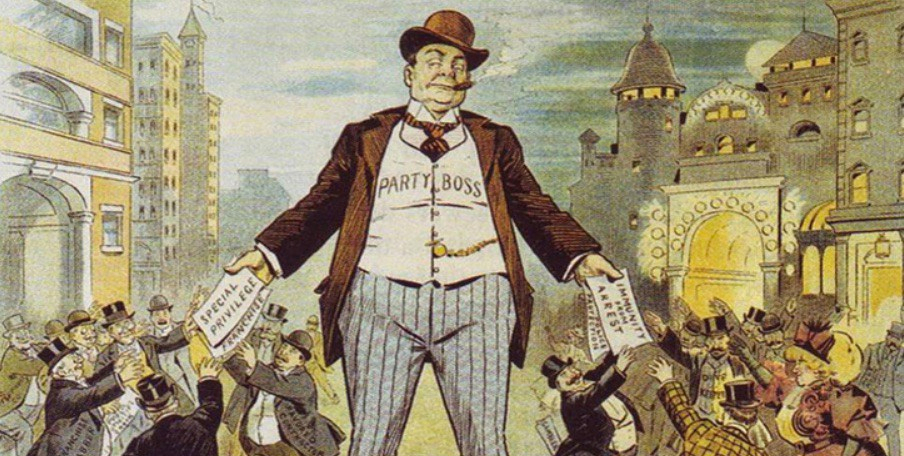
  • Why Bernie Sanders Would Win in 2020

    Why Bernie Sanders Would Win in 2020

    With an imminent climate catastrophe only 12 years away, healthcare being the number one cause of bankruptcy in the wealthiest country on earth (with 78% already insured), the oligarchy’s stranglehold on the working-class now stronger than ever, stagnating wages that haven’t kept up with inflation, a human rights crisis in the middle-east, and a student debt crisis that stagnates economic growth, there is only one proper agenda that can address these key issues. Vermont Senator, “Amendment King” Bernie Sanders’ has been fighting for these very New Deal style democratic policies his entire life. While the Democratic party moved right on the political spectrum, policies supported by the majority of Americans – those at the core of Sanders’ agenda – became deemed ‘fringe.’ This is what makes Senator Sanders the strongest, most viable candidate for the 2020 Presidential election. No more fossil fuel pawns with charismatic authority, mortgage fraud criminal defendersbig pharma gatekeepers, or more plutocrats selling the middle-class increased domestic survellaince powers and voting for $716 billion military industrial complex spending bill and deregulating Wall Street. Lesser of two evils doesn’t suffice.

    Bernie Has the Poll Numbers Across Demographics. Republicans Like Him More Than They Like Democrats.

    The American people have overwhelmingly spoken in favor of Bernie Sanders: 58% of non-white voters, that is 73% African American support among voters, 68% among Hispanics, 62% among Asian-Americans, 56% among women, 62% among 18-34-year-olds and 78% among Democrats. These are your ‘Bernie Bros,’ mainstream media.Please continue lecturing us millions of simpletons on why we should vote against our best interest and for corporate pawns.

    Sanders has also proven to be an effective, mediating, bipartisan voice, reaching across the aisle in CNN town halls and making Trump voters ‘feel the bern.’ Time and time again, his centered economic message has reached coal country effectively with none of the dripping ‘liberal east coast elite’ condescension.  Recall the West-Virginia townhall where a county of Trump voters thanked Bernie and clapped for raising taxes, Medicare for all, and free college. His working-class message would’ve obviously resonated with disgruntled Trump voters on it’s own, but his ability to effectively communicate across the aisle would’ve done numbers.

    There is a reason Sanders, who proudly calls himself a socialist, remains the most popular politician in America per a Fox News poll.  There’s a reason he has a higher approval rating than any democrats or republicans on the hill. It’s not just his unwavering earnestness, pseudonym as the “amendment king,” or clean corporate-interest free record. It’s media obfuscated fact that the majority of the country supports progressive policies and the majority of the electorate identifies as independents.

    Bernie Would Have Won

    Americans made their voices heard in the 2016 primaries, but like with everything supported by middle-class, was drowned out by the corporate party elite. In 2018, ex-DNC chair Donna Brazile revealed the Democratic Nation Committee essentially rigged the primaries in favor of Presidential candidate Hillary Clinton. This confirmed what we all suspected. With Sanders’ rallies regularly turning out by the tens of thousands, the results puzzled us. Undemocratic superdelegates aside, hundreds of individual reports had surfaced of voter suppression against Sanders voters. Donna Brazile, revealed the DNC and Hillary Clinton campaign collusion ran deep – the victory fund agreement was signed four months after Hillary announced her candidacy, a year before the nomination. Hillary Clinton’s campaign had control of the party before voters decided. And there has been no Congressional investigation, no FEC investigation for interfering in an election.

    Polls during the primary season consistently showed  Sanders handily defeating Trump by 10 points or more, while Clinton led him by only a few points. This is easy to fathom considering Trump secured the nomination when Hillary lost the three historically blue states that Bernie did well in during the primaries. Sanders beat Clinton in Wisconsin and Michigan. And the DNC chosen candidate lost Pennsylvania.  Narrow margins of eight-tenths, three-tenths, and 1.2% in these three Rust Belt states where Sanders’ message resonated, handed the election to Trump.

    Bernie Has the Rust-Belt Part of the Obama Coalition

    What happened? These states usually swing blue. Well, working-class whites who previously voted for Obama were fed up with establishment politics and an unresponsive plutocracy in general so they voted for the only general election candidate who wasn’t bought by Wall Street and promised to remedy working-class struggles. Who else had an populist, working-class message and wasn’t absolutely lying about it? Sanders who made economic inequality the platform of his campaign would have obliterated policy-outline-free and economically illiterate Trump. But he won, and the country lost thanks to democrat hubris.

    Left-wing policies are were the numbers are at. And analyzing the historical loss is key to avoiding the same mistakes. Unfortunately, most pundits and strategists are tone-deaf and incapable of any self-reflection. So not only did Hillary fail to draw Obama voters, but she also experienced the downfalls of low-voter turnout that come with a centrist, No-Hope, purely opposition campaign. She won 55% of the vote compared to Obama’s 69% in 2012, seeing a decrease in support from black, Latino,  young voters and non-college whites. She lost the rust-belt Bernie had won the primary in, lost the millenial vote Bernie gained more votes than both Trump and her combined, and garnered only 28% of the non-college white vote where Obama had previously won 40% of in 2012.

    The first female to win the nomination for president didn’t even gain 50% support from white women against the sexual assaulter and unabashed misogynist. Compared to Obama’s 93% of the black vote, Hillary garnered 88% of the black vote against a candidate who was sued twice by the DOJ for not renting to African Americans. And 65% Latinos vs 71% for Obama against a candidate who called them rapists. Most damaging, 54% millennial support, compared to obama’s 60%. Guess who draws millennials? Bernie Sanders and his progressive policies. In fact, more young people voted for Sanders than Clinton and Trump combined. He has 62% of the 18-34 voter electorate. Teenagers literally run after him screaming like he’s a rockstar. Not to mention there wouldn’t have been a spoiler effect in Florida from disgruntled Bernie supporters who voted for Jill Stein if he would have been the nominee.

    Elections Should be About Issues not Cult of Personality.

    As Sanders has always said, it’s not about a person but a movement. And the majority of Americans want a new New Deal. If he were to abandon his thirty-year-spanning agenda, his supporters would turn from him. This is why the independent senator from Vermont with zero campaign money, name recognition, and a self-proclaimed democratic-socialist label managed to not only run the most progressive campaign in US history but ran the most successful independent, grassroots campaigns in modern history. Against the brand-name Clinton machine at that. The crowds upwards of 20,000 were a sign of the changing political climate and rising populist revolt. His immense, insurgent success despite the political establishment’s relentless smear campaign was a physical manifestation of polls showing tremendous favorability towards progressive policies and a growing independent base. All of this ultimately forcing the DNC to to deliver the most progressive party platform in history.

    Fifty-eight percent  of Americans support single-payer, 88% oppose cuts to Social Security, voters in red states want Medicaid expanded, 68% think the wealthy pay too little taxes, 64% support regulating greenhouse gas emissions,58%  support breaking up big banks, 63% support raising the minimum wage to $15.00, 53% support labor union law, 64% think corporations don’t pay their fair share.

    The 2016 election proved people wanted populism and a platform for the working class, not career politicians grappling with being in the pockets of big money interests and trying to get reelected. Populism won no matter how much of a lie it turned out to be.

    Corporatist Establishment Democrats Would Lose

    There exists much misplaced hype around petroleum industry /U.S. Representative Beto O’Rourke. While his election as Senator would have been tremendous progress for Texas, an examination of his highly-ignored voter record proves it would not be so much for the United States if Democrats want to beat Donald Trump. This may be tough for the cult of personality centrists to believe, but we don’t need another corporatist politician who voted to deregulate banks, voted to fast-track TPP, is number two below Ted Cruz fossil fuel industry recipients, and “frequently voted against the majority of House Democrats in support of Republican bills and Trump administration priorities.”

    The same people who brought you Hillary “Secret Wall Street Speeches” Clinton, who lost in the most easily winnable election against a reality-star con-artist demand you ignore public records while the earth will become uninhabitable in many places by 2040Their message boils down to, “Bernie old white man bad – Biden & Beto white men good!”

    No more oil company shills winning on charismatic authority, mortgage fraud criminal defenders, big pharma gatekeepers, or more plutocrats selling the middle-class increased domestic surveillance powers, voting for $716 billion military industrial complex spending bill and deregulating Wall Street. We need a candidate whose agenda stands for issues the majority of Americans support – single-payer, higher wages, access to higher education, criminal justice reform, green energy – and that is Bernie Sanders. If he were to abandon these positions his supporters would abandon him. Tough for the cult of personality centrists who rally around the insurance industry, and big oil to understand, I know. Faux populism won in 2016, and Bernie so far is the only honest candidate who has made working-class populism his career-agenda.

    Bernie’s New Deal

    Standing against Bernie Sanders means standing against Medicare for All, the fiscally responsible $2-trillion-saving plan which is cheaper than premiums. (Because despite paying twice as much per capita as other countries in healthcare, leaves 30 million uninsured.) It means standing against economic justice – a $15 minimum wage, closing corporate tax loopholes, unions, and pay equity for women and minorities. (If the minimum wage had kept up with inflation, it would be $21.00.)

    To oppose his agenda is to oppose ending Citizens United, ending voter suppression and gerrymandering, criminal justice reform in a country that spends $80 billion a year imprisoning more people than any other country. It means opposing aggressively combating impending climate change destruction by moving towards sustainable energy.

    It means hating investing in the working-class who has the highest MPC, through $2-trillion-saving healthcare, tuition-free public college, expansion of social security, and green energy jobs. It means opposing foreign policy based on diplomacy and human rights, a cleaner planet, and enacting true economic justice. This is only possible when a leader isn’t beholden by corporate interests.

    Reject Propaganda. Organize.

    The unsubstantial attacks from the mainstream media outlets have already begun. Party Democratic elites with an agenda are throwing every trite ‘Bernie Bro’ narrative and the kitchen sink while failing to actually discuss any policy.  The “Third Way” a group of Wall Street is already running opposition ads against Senator Sanders in primary states. We must halt these negative narratives about single-payer, and correct the record on Bernie’s positions and efficiency of his proposals. On his D- rating from the NRA, on that he wasn’t an effective legislator, and that he “made Hillary lose the election” by simply running a primary campaign with better politics.

    The establishment has realized the Bernie Bros narrative doesn’t stick with the 58% non-white support he has. Could it be that economic inequality is decimating the middle-class as the wealth gap grows between minorities and Caucasian workers? African American women earn 64 cents and Hispanic women 55 cents for every dollar made by a white male. Despite what pundits might say, we’re seeing past the corporatist Democrats’ identity-politics-entrenched bromides, and looking for real economic justice. Because tokenism isn’t a measure of progressiveness when candidates sell us wars, vote against lowering pharmaceutical prices, and shill for Wall Street.

    Amidst a political arena of corporatist plutocrats, in a dystopian hellscape where people die crowdfunding for insulin online, and millions will die in decades of unmitigated climate-change induced disaster, Bernie Sanders is the change we desperately need. Trump won because of faux populism, because of people who rejected corporatist war-hawk Hillary. What makes Democrats think Beto “Oil Shill” O’Rourke, Cory “Big Pharma Bro” Booker, or Kamala “Mortgage Fraud Defender” Harris are feasible contenders for the Rust Belt voters who crossed over to Trump in states Bernie won the primaries in? Or to millenials Bernie has 62% of the support from?

    Bernie is the hero America needs in 2020, and wants according to poll numbers. The problem is he’s not the leader corporate interest groups or the colluding DNC wants. Bernie Sanders needs to run in 2020 because he’s been on the right-side of history regarding health care, economic justice, climate change for decades, and he would represent ordinary Americans’ best interest.

  • Legalization: The End to Mexico’s Drug Violence

    Legalization: The End to Mexico’s Drug Violence

    Over a decade after former President Felipe Calderon launched a militarized crusade against drug cartels, Mexico has recorded its highest homicide rate of 19.4 since the interior ministry began keeping records, with a staggering 29,168 murders in 2017. Despite lethal military deployment and a winning ‘kingpin-strategy’ (Nieto has neutralized 89% of drug-cartel leaders on his list), it has only culminated in spikes of drug-violence that have left over 175,000 dead in the last 10 years.  That is, because military force won’t halt the leading U.S. demand for drugs (and weapon smuggling), eliminate the incentive to join cartels in a poverty-stricken country with farmers hurt by NAFTA, or the corruption which the narco-state burgeons on.

    The cartel violence reigning down in Mexico is the result of a profitable illegal industry competing for territory, empowered by corruption, and sustained by poverty. A decade of failing drug war policy requires a different kind of diplomacy – a way to remove the profit incentive altogether. The government  has amped up organized-crime-combatting efforts, but security analysts agree that they’ve unwittingly led to a violence-wave as kingpins fight for control. Legalization of drugs is the quickest death to cartels and their endless terror.

    Although such a far-fetched proposal is considered political suicide on both sides of the border, it’s a strategy which has been economically and statistically proven to work by the growing number of U.S. states legalizing marijuana. Marijuana legalization has already slashed cartel profit and decreased violence in Mexico. Marijuana seizures on the U.S.-Mexico border are down from 4 million pounds (2009) to 1.5 (2015) with the Mexican army seeing a 32% drop in confiscations. (The lowest levels in the last decade.) Subsequently, this has resulted in what military force has failed to do – decreased violence.

    Legalization eliminates the astounding U.S. demand fueling the black market. Nonetheless, to understand solutions, we must understand the causes. The U.S. is the leading consumer of drugs – more drugs are purchased by them than the rest of the world combined. After the Decada Perdida where 800,000 jobs were lostby the 90s, 85% of U.S. cocaine came through Mexico. During Felipe Calderon’s term, the Mérida Initiative of militarized-combat was put into effect as the mean to a fruitless end. A whopping U.S.-sponsored $1.6 billion later, and the war between drug cartels  has killed 63,000 in the past six years.

    Without demand for an illegal good, there would be no black market. Black markets fuel violence since disputes can’t be resolved within legal institutions, but rather with U.S. smuggled guns. (Seventy-percent of guns seized in Mexico and traced by the US Bureau of ATF from 2009 to 2014 came from the US). Without demand there would be no drug crime, or the skyrocketing levels of corruption generated by participants infiltrating municipal police forces, and bribing the legal system.  A level so high it leaves the country ranked at 123rd among 176 countries in the 2016 CPI. Legalization would eliminate the profit-incentive for cartels to exist – and therefore impose violence and corrupt the governmental system.

    According to the Washington Post, it’s estimated that a “$2,000 kilogram of cocaine could be imported for less than $50 and sold for a small markup from its price in Colombia.” While criminalization drives the cost to $20,000, retailing for over $100,000. Without these profits, the cartels and their heinous crimes against humanity would cease.

    Public health qualms about such a radical proposal are often raised, but countries that have decriminalized have seen little to no increase in drug use. For one, Portugal’s drug decriminalization has reduced drug-related harm. Drug use has decreased since, with rates maintained below the European average (far lower than the U.S.) Furthermore, state-control prevents overdoses and spread of disease caused by a lack of regulation.

    However, drug violence doesn’t operate in a vacuum; the epidemic is created through decades of complex sociopolitical conditions. One of those being the 45.5% poverty rate of a country ranking 13th in GDP. In a recent presidential debate MORENA candidate Obrador rightfully argued that reducing poverty was the only way to fight cartels. It’s join or starve for many that find themselves without job prospects or educational attainment. And cartels recruit from this urban unemployed sector. The 1980s economic crisis which resulted in 800,000 job losses exacerbated inequality and eliminated upward mobility opportunities.

    These conditions were aggravated by NAFTA which hurt farmers with the removal of tariffs and quotas on imports. Farmers then resorted to growing marijuana to survive due to the removal of these subsidies.

    Furthermore, corruption facilitates mass violence. The country earned the narco-state label due to the number of police are involved in kidnappings, extortions, and protection for organized crime in exchange for bribes. They’re considered the most corrupt public-institution in the country, with the lowest reliability for crime protection. To decrease corruption levels, they must continue down the path of firing corrupt officials as Attorney General Morales has with 10% of the police force. It must also raise police salaries of $588 a month. The benefits would exceed the cost (which is over 10% of GDP.)

    Decades of the drug war has resulted in Mexico’s highest homicide rate since its recorded history. It’s cost the country not only US $134 billion, but endless lives. Mexico must eliminate the black market by decriminalizing, expand poverty-relief programs to prevent cartel recruitment, clamp down on corruption by overhauling its police force, and end weapon smuggling.