Tag: politics

  • Economic Populism Can Combat Democrats’ Declining Minority Support

    Economic Populism Can Combat Democrats’ Declining Minority Support

    Trump won the highest share of non-white electorate vote of any Republican in 60 years, while moderate Democrats lost support and seats. Despite Joe Biden’s expected narrow win, Democrats face a disconcerting problem from declining minority and Latino support that can only be regained through the proven-effective economic populism of the likes of Bernie Sanders. According to the Edison Research exit poll, Trump garnered 32% of the Latino vote, 31% of the Asian vote, and 12% of the Black vote. While pundits may blame stereotypical voting motivators like “machismo,” or conservative social policies, they’re not rooted in reality. Polling consistently shows that Latinos’ primary voting concerns are jobs and the economy. This downward trending support for Democrats points to a lack of attention to Latino voting concerns from the Biden campaign and a corporatist Democratic platform that doesn’t resonate with working-class people of all backgrounds. Biden ran a sufficient, but mostly opposition-campaign that ignored Latino voters—the largest nonwhite voting block (32 million) according to political insiders. As voters of color grow as a share of the electorate, the Democratic party must address their economic policy concerns through effective outreach, while fighting fake news. When Latinos list the economy and jobs as their primary issues, maybe it’s time to consider economic populism like Bernie (who fared better than Biden among them) did. 

    According to the exit poll, Trump just won the highest share of non-white support of any Republican in 60 years. He did better with every gender and race except white men (5 point decline.) He gained 2% with white women, 4% with black men, 4% with black women, 3% with Latino men, and 3% with Latino women, and 5% with ‘other.’ Although exit polls are not empirical fact, these voting estimates fall in line with 2016 results. AP VoteCast calculates that Trump won 8% of the Black vote (a 2 percentage-point gain on his 2016 numbers.)

    While this harrowing support came as a shock to many on Tuesday, as birther-in-chief Trump has repeatedly attacked minorities with hateful racist actions and sided with white supremacists, 29% of Hispanics have identified as Republican for the last two decades. If we’re to ever finally flip states like Texas with sizable and rapidly growing Hispanic voting blocs, it’s crucial that we actually court their vote with economic policy substance and messaging. While also fighting fake news that endlessly pushed lies like Biden calling African-Americans “super-predators” to that demographic. This year also saw an increase in  Spanish-language social media disinformation aimed at Democrats.

    Latinos for Trump

    Latinos support for Trump isn’t surprising but the causes (messaging and faux populism) must be examined if we’re to ever flip states like Texas. Florida Hispanics’ 47% Trump support seems like a lost-cause, but when 40% of Hispanics in Texas vote for the man who directly characterized their immigrant population as rapists and drug traffickers who “bring crime,” it points to a Democratic failure that must be addressed. This 40% figure is higher than the 32% national Hispanic support Trump won.

    Democrats Lack Economic Policies and Outreach

    Democrats have complacently resigned to the myth that Latinos are all Democratic — and have continued losing support through a lack of economic populism and outreach by moving to the corporatist right. All while Biden ignored Latino voters in the 2020 presidential election. They’ve abandoned their New Deal-style platform that gave birth to the middle-class. The solution is returning to a working-class party — for the working class. Bernie Sanders’ primary success among Latinos has proven that populism works — talking jobs, the economy, and addressing working-class needs works. 

    Joe Biden won the primary in-spite of his efforts to gain Latino voters. Over 20 Latino political insiders said they saw zero plan from Biden to gain Hispanic voters and there’s little evidence the campaign is devoting resources to mobilize the Latino vote.“I do not think that the Biden campaign thinks that Latinos are part of their path to victory,” said Jess Morales Rocketto, the former digital organizing director for Hillary Clinton’s 2016 campaign. “If you don’t think Latinos are part of your path to victory, then you do what they’re doing.” “Right now I can’t tell what their strategy is with the Latino community. I just don’t see it,” said one Latino lawmaker who requested anonymity to speak candidly.

    Moreover, centrism is to blame for declining minority support. The only seats that Democrats lost this election were centrists. No progressives lost their seats. And sticking to centrist, corporatist politics would deliver catastrophic losses in 2022 for Democrats. 

    So while a bloc of Latinos has always voted conservative — 37% in 1984, 27% in 2012 — their conservatism is not fueled primarily by social issues but by economic messaging. Turning states like Texas blue can be done, Beto O’Rourke only lost by a narrow two points of Sen. Ted Cruz, R-Texas. Democrats just need a policy platform shift towards progressive economic policies and a serious turnaround in messaging. 

    Latinos’ Political Philosophy

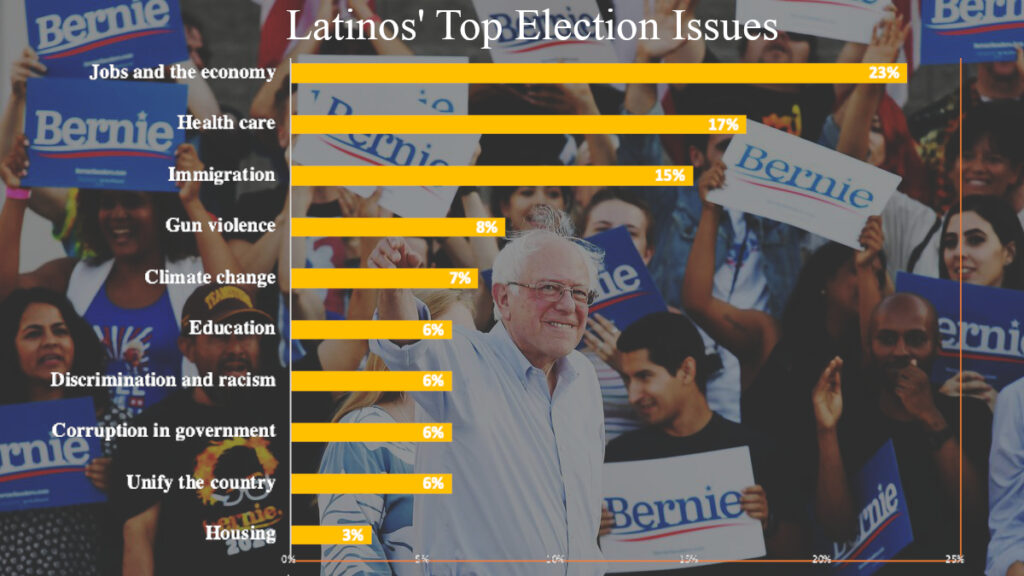
    Ignoring the policy concerns of 18% of the U.S. population and 32 million voters is a sound way to guarantee even more congressional losses in 2022. Latinos’ primary voting concern is not immigration or elusive “unity,” but rather, jobs and the economy — it ranks first at 23% in a Unidos US Electorate Survey. There can be no equality or unity without economic justice — it’s what directly affects the livelihoods of hard-working families. Democrats have abandoned this messaging in favor of the oligarchy’s corporate interests and obfuscated that with platitudes.

    Latinos also ranked healthcare as a primary issue — concerned that it’s too expensive and unaffordable. These two policy concerns they cited that the ideal candidate would address hold up nationally, in Arizona, California, Florida, Nevada, and Texas — all heavily populated Latino states. Nationally and in these states they also cited student loans and college cost concerns, social security cuts, and housing affordability in addition to concerns over Trump’s treatment of immigrants.

    A democratic platform that cares about Latinos — the largest voting bloc — supports free college, Medicare for All, and economic justice in general. Democrats don’t push for the (faux) populism that Trump did in 2016. 

    Bernie Sanders’ Economic Populism Wins Among Latinos

    Economic populism is the reason Bernie Sanders fared much better among Latinos than Biden.  got less minority support than Hillary who had less than Obama. The reason Trump did better with people of color is that he improved support through simple economics and jobs class language. While Democrats focused on a pure opposition campaign that lacks class language.

    Bernie Sanders won landslide levels of Latino support — 53% in Nevada — three times as much as Joe Biden who got 17%. He also won 49% in California, compared to Biden’s 19%. This is because he hired Latino activists that actually knew how to deliver economic justice message through outreach like Belén Sisa, his Latino Press Secretary.

    Bernie Sanders actually offered substantive solutions to Latinos instead of just offering platitudes about unity and brushing the entire voting bloc’s concerns as being about immigration alone.

    National Progressive Policy Support

    It’s no surprise then that Sanders was voted the most popular politician in America per a Fox News poll.  There’s a reason he has a higher approval rating than any Democrat or Republican on the hill. It’s not just his unwavering morals, pseudonym as the “Amendment King,” or corporate-interest free record. It’s an obfuscated fact that the majority of the country supports progressive policies and the majority of the electorate identifies as independents.

    Fifty-eight percent of Americans support single-payer, 88% oppose cuts to Social Security, voters in red states want Medicaid expanded, 68% think the wealthy pay too little taxes, 64% support regulating greenhouse gas emissions,58%  support breaking up big banks, 63% support raising the minimum wage to $15.00, 53% support labor union law, 64% think corporations don’t pay their fair share.

    The Democratic party once cared about these working-class issues — John F. Kennedy once advocated for Medicare For All and Eisenhower’s top tax bracket was 90% when the middle-class was booming.

    Bernie didn’t patronize Latinos with empty platitudes, or Despacito, or by sprinkling Spanish words here and there. He listened to the concerns that after working-class people and offered substantive solutions centered around free education, universal healthcare, higher wages, and more.

    Neo-liberalism lost in 2016 after years of democratic establishment politics failed to deliver hope and change. Working-class whites who previously voted for Obama were fed up with establishment politics and an unresponsive plutocracy so they voted for the only general election candidate who wasn’t bought by Wall Street and promised to remedy working-class struggles. Who else had a populist, working-class message and wasn’t lying about it? Sanders who made economic inequality the platform of his campaign would have obliterated Trump. But he won, and the country lost thanks to democrat hubris.

    Left-wing policies are where the numbers are at. Hillary failed to draw Obama voters and experienced the downfalls of low-voter turnout that come with a centrist, establishment, purely opposition campaign. She won 55% of the vote compared to Obama’s 69% in 2012, seeing a decrease in support from black, Latino,  young voters, and non-college whites. She lost the rust-belt Bernie had won the primary in, lost the millennial vote Bernie gained more votes. Both Trump and her combined, and garnered only 28% of the non-college white vote that Obama had previously won 40% of in 2012.

    To avoid even more major losses, Democrats must turn to progressive policies supported by the majority of Americans instead of platitudes and pandering. 
  • Losing Trump Campaign’s Ballot-Count Protests and Lawsuits Emerge

    Losing Trump Campaign’s Ballot-Count Protests and Lawsuits Emerge

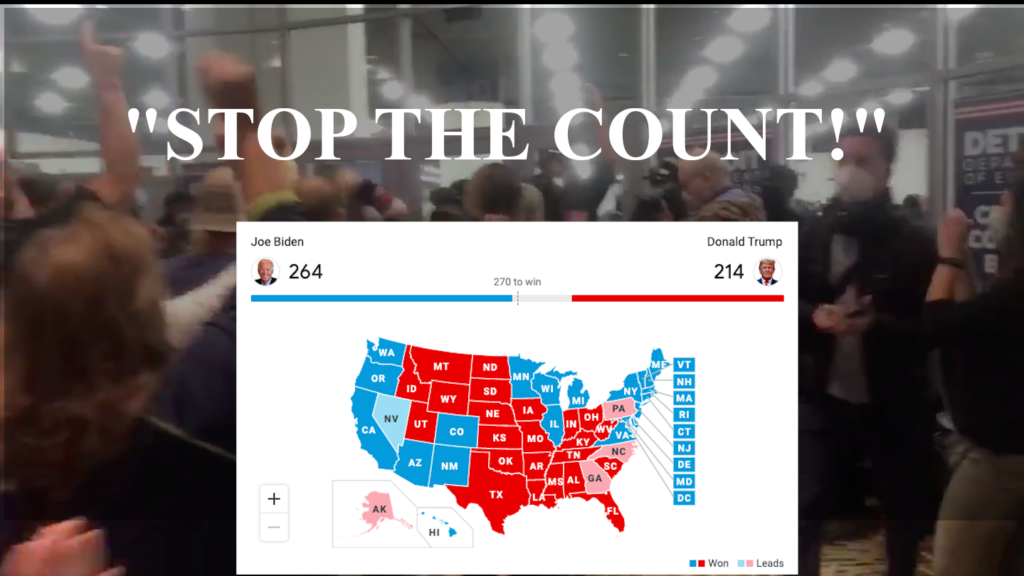
    After vowing to go to Supreme Court over ‘fraud’ and refusing to commit to conceding to election results for months, the rapidly sinking Titanic of a Trump campaign announced legal action in Wisconsin, Michigan, and Pennsylvania after today’s counted ballots are securing a Joe Biden win. Belligerent Trump supporters barged into Detroit’s Central Counting Board to try to stop the ballot count, alleging that counting, is tantamount to fraud. These desperate attempts are a sad display of a deflated ego, as Trump’s recount in Wisconsin where Biden won by 20,517 votes, won’t occur until December 1st. In Michigan, he’s suing to stop the count on the basis that his poll-watchers aren’t allowed to sit closer to the counters. Biden has won Michigan by 70,511 votes.

    The Biden campaign will have barely won over the strongest attack on voting rights and  disinformation epidemic in American history. Republican legislative efforts to suppress the vote have long occurred in Wisconsin, Pennsylvania, Nevada, Florida, Illinois, Georgia, Texas, Michigan, Iowa, and more states. The tactics include purging voter rolls like in Georgia and Ohio through ‘use-it-or-lose-it’ laws backed by Trump’s Justice Department. Through this law, over 850,000 eligible Georgia voters were removed off the rolls in 2015. 

    This election, the Texas Supreme Court had to reject a Republican effort to toss almost 127,000 Harris County votes. And Republicans mobilized 50,000 “poll watchers” to suppress the vote after a 1982 consent decree banning voter intimidation tactics expired Moreover, Trump’s Postmaster General’s sabotaging of the post office is another method destroying our electoral infrastructure. He removed sorting machines and post office boxes, cut overtime work, fired postal veterans, and caused delays.

    In Trump’s farewell tantrum, he said he will sue to halt counting in Michigan, sue to halt counting in Pennsylvania, and request a recount in Wisconsin. His suspicion against votes swaying Democratic comes after he spent months telling his base to not vote by mail. 

    Devastated Trump supporters who Trump told to “stand back and stand by” to, have taken up protesting against ballot-counting — barging into an official counting facility in Detroit and chanting, “Stop the vote!” If any other demographic committed violent attempts to disqualify voters, the law enforcement response would be very different.

    Crowd chanting to stop the vote/stop the count at Detroit absentee counter center. pic.twitter.com/pdJWmwbvzR

    — Seema (@LATSeema) November 4, 2020

    Aggressive challengers causing havoc at Detroit’s Central Counting Board. Make no mistake, operatives’ efforts to disenfranchise and to disqualify ballots will be focused on areas with large numbers of Black voters and voters of color. #CountEveryVote pic.twitter.com/EHE2d6oGZo

    — Kristen Clarke 866-OUR-VOTE (@KristenClarkeJD) November 4, 2020

    #BREAKING: Large, animated crush of “stop the count” protestors trying to push their way into TCF hall in #Detroit where ballots are being counted.

    They’re being blocked by guards at the door.

    Pizza boxes are pushed against the window to obstruct view. It’s tense. @NBCNews pic.twitter.com/zFhzd88skX

    — Steve Patterson (@PattersonNBC) November 4, 2020

    This political violence is no surprise after Trump has incited terror these past four years — from calling violent neo-nazis “very fine people,” to saying police should “rough” detainees up, to encouraging supporters to attack protestors saying he would “pay [their] legal fees. 

    Trump cheered supporters who committed a criminal offense by swarming a Biden bus in Texas and attempting to “run it off the road.” The FBI is investigating this dangerous act. This is just one of many acts of political violence and threats that have emerged alongside right-wing domestic terror.

    Nevertheless, we will emerge from the ashes of a Trump presidency that has felt like a century through its hateful destruction of progress. We will rise, rebuild, and push for progressive policies. We will stand up with dignity for the future of our children, the climate, economic and racial justice. 

    Congratulations to our soon-to-be president-elect Joe Biden.

  • Voter Suppression Is Killing Our Democracy

    Voter Suppression Is Killing Our Democracy

    A staggering 233 election cases are pending in federal courts facing off over voting rights during an election in a pandemic. Voter suppression rulings are already underway. Recently, a 5th U.S. Circuit Court of Appeals reinstated Texas’ process for tossing absentee ballots over mismatched signatures, determining that the right to vote by mail is not guaranteed by the 14th Amendment. This comes after governor of Texas, Greg Abbott, limited large counties to a single ballot drop box. While in Alabama, the Supreme Court blocked curbside voting (5-3) in a state with no mandatory face covering law during the pandemic. With these shocking voter suppression tactics taking place, it should be no surprise that we’re seeing 12-hour lines around the country. Voter suppression efforts are not new, since the Supreme Court ruling in Shelby County v. Holder in 2013, Republican legislators have passed many voter suppression laws which have resulted in the purging of voter rolls, limits to early voting, felony disenfranchisement, and gerrymandering. All on top of the Trump administrations’ deliberate efforts to damage election infrastructure by sabotaging the post office from within. With a Senate majority, Democrats will hopefully be able to fully restore the Voting Rights Act of 1965.

    On October 19, the Fifth Circuit Court of Appeals egregiously determined that voters don’t have a Constitutional right to vote by mail. This Texas ruling blocks district judge Orlando Garcia’s prior ruling requiring officials to notify voters whose ballots were rejected due to a signature mismatch. Over 5,000 ballots were legally rejected back in 2016 and 2018 combined for this rule and advocates worry this may suppress the vote. Despite these measures over 4 million Texans have already cast their votes, leading the country in early voting numbers.

    “Besides describing the right to vote as fundamental, the plaintiffs have not explained what there is about the right to vote that makes it a liberty interest. The right to vote does not immediately resemble the rights described in Roth, 408 U.S. at 572. The plaintiffs cite no circuit or Supreme Court precedent extending the label of “liberty interest” to the right to vote. The Sixth Circuit, the only circuit to squarely address this issue,22 held that the right to vote does not constitute a liberty interest.”

    Source

    The 14th Amendment, adopted after the Civil War in 1868 to grant emancipated slaves full citizenship, states, “No state shall … deprive any person of life, liberty, or property without due process of law, nor deny to any person … the equal protection of the laws.”

    The Fifth Court’s ruling is a distortion of that 14th Amendment made to protect vested power. It distorts it just as San Mateo County v. Southern Pacific Rail Road established corporate personhood when Senator Roscoe Conkling claimed the 14th Amendment was not limited to natural persons. 

    In the 5-3 Supreme Court vote that banned Alabama curbside voting, Justice Sotomayor dissented, quoting a Black plaintiff in his 70s with Parkinson’s disease and asthma who said while he was willing to die to vote as his ancestors had, “We’re past that time.”

    Image
    Image

    A district judge also blocked Texas governor Greg Abbot’s efforts to remove ballot drop off locations in densely populated counties to the effect where a county with 4.7M people would have the same number of locations as one with 169. These efforts to limit voter access point to an insecurity of formerly solid red state Texas being able to win fairly.  He planned to limit huge counties to one ballot drop box.

    Voter Suppression Efforts

    Voter suppression isn’t just limited to court battles, it can come by way of voter intimidation as the GOP has by by recruiting 50,000 “poll watchers” who will be deployed to majority Democratic voter polling stations. Voter intimidation tactics were banned in a 1982 consent decree after Republicans sent police to minority neighborhoods to intimidate voters. However, in 2018 the decree expired and now Republicans are mobilizing 50,000 “poll watchers” to suppress the vote.

    Voter suppression no longer pretends to be an effort to protect against voter fraud but its flagrant racist, undemocratic tactics are a campaign to control election outcomes by limiting who votes the most. Republican legislative efforts to suppress the vote have occurred in Wisconsin, Pennsylvania, Nevada, Florida, Illinois, Georgia, Texas, Michigan, Iowa, and more states.

    The tactics include purging voter rolls like in Georgia and Ohio through ‘use-it-or-lose-it’ laws backed by Trump’s Justice Department. Through this law, over 850,000 eligible Georgia voters were removed off the rolls in 2015.

    Limiting early voting is another method used to suppress the vote. In Texas, a court recently rejected a GOP effort to limit early voting.

    Gerrymandering is a classic voter suppression effort that undermines our democracy by redrawing electoral districts to favor one party.  After 2010, the GOP redrew districts to favor GOP candidates in project REDMAP resulting in the GOP earning more seats despite getting less votes. 

    Moreover, Trump’s Postmaster General’s sabotaging of the post office is another method destroying our electoral infrastructure. He removed sorting machines and post office boxes, cut overtime work, fired postal veterans, and caused delays.

    Restoring the Voting Rights Act of 1965

    Since the Supreme Court gutted the Voting Rights Act in 2013, 1,688 polling places have closed. With 233 election cases related to COVID-19 pending, outcomes on the future of our democracy are uncertain. It’s crucial that our country votes in senators that will restore the Voting Rights Act of 1965 to preserve the foundation of our democracy that voting is.

  • Tax Law: How the Wealthy Get Away With Evasion

    Tax Law: How the Wealthy Get Away With Evasion

    While billionaires brag about tax evasion, the highest tax burden as a percentage of income falls on the poorest Americans. The lowest 20 percent of taxpayers pay a tax rate more than 50 percent higher than the top 1 percent of households. This should come as no surprise after the Panama Papers bombshell of 2016 that revealed rampant tax evasion from the oligarchy. Most recently, President Trump’s tax returns revealed that he paid $0 in federal income taxes in 10 out of the 15 past years and just $750 in 2016 and 2017 per a New York Times report. This unfairness — part in due to huge losses and tax breaks for real estate developers — point to a larger problem of income inequality in America. The problem is a lot of it is legal. Tax law in this country bears the burden on the working-middle-class families while billionaires like Amazon evade taxes while exploiting those very working-class employees who create their wealth. 

    Trump has paid about $400 million less than the average highest-earning 0.001% of tax filers in the US does. This is in part due to tax breaks, inflated write-offs for $70,000 in hair care, consultation fees, and falsely classifying personal estates as “investment properties” to reduce his taxable profit. and huge losses.Trump’s tax returns revealed“struggling properties, vast write-offs, and hundreds of millions in debt coming due.” The IRS will determine whether he broke the law after his audit. But he did illegally take $70,00 in tax deductions for hair care according to The New York Times’ expose. 

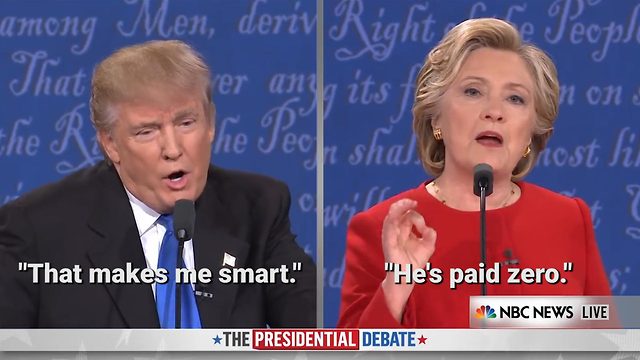
    The racist, tax-evading, con-man in chief has called himself smart for not paying taxes yet rails about illegal immigrants who pay $27.2 billion in federal, state, and local taxes each year. Corrupt plutocrats are openly bragging about cheating the system.

    How Did Trump Avoid Taxes?

    It’s all due to a combination of tax breaks and huge losses. Real estate moguls get tax breaks such as deducted interest on loans to reduce their taxes. Unlike people who take out credit cards and pay high interest rates who don’t deduct their interest. They gain another tax break on depreciation even if the building is appreciating. (Something about him being a conman and hypocrisy against immigrants)

    Since 2000, Trump has reported hundreds of millions of dollars in losses on golf courses alone. Tax records show that his Trump International Hotel in D.C. lost $55.5 million along with big casino losses in Atlantic city.

    The wealthy use losses to cancel out other income and harness the power to accountants and lawyers while making money flow to tax-exempt organizations or offshore.

    However, Trump is an exceptionally bad businessman who paid no taxes for 10 years because he had massive losses year after year due to dumb investments. This revelation should come as no surprise as the conman stiffed vulnerable Americans through fraudulent “Trump University,” regularly stiffed contractors, and even stole kids’ cancer charity funds

    Moreover, personal expenses written off as cost of business vastly reduced his tax liability. Only the IRS audit will determine if those write-offs (such as a $70,000 for his hair care, $100,000 for his daughter Ivanka’s) were illegal. 

    To further reduce his reported profit, the NYT expose revealed that he classifies his personal estates as “investment properties” and reports inflated “consultation fees” for nearly all of his projects. For just one property, he  “has been able to write off $2.2 million in property taxes since 2014.” 

    His $72.9 million tax refund is also the subject of a battle with the IRS.

    Tax Evasion

    The Panama papers, a massive document leak published by  International Consortium of Investigative Journalists in 2016, revealed how the world-wide oligarchy commits tax evasion through offshore tax havens. However, the largest proportion of  tax-avoidance is committed legally on US soil through a system of infinitely deferred capital gains taxes, false write-offs, weakened estate tax, and shrinking top tax rate that allows billionaires to literally never pay taxes.

    In 2018, Amazon paid $0 in U.S. federal income tax on over $11 billion in profits before taxes. It also received a $129 million tax rebate from the federal government. This is all while the lowest 20 percent of taxpayers pay a tax rate more than 50 percent higher than the top 1 percent of households. 

    The Wealthy’s Tax Code

    But how is this tax-avoidance possible? It’s simple. Income from wealth is taxed more lightly than labor income (which accounts for 80% of total income). This is all while the top one-percent’s capital income enjoys preferential tax rates. Tax code also allows the wealthy to exclude much of their income from tax returns – because it’s investment income. 

    The reason billionaires like Jeff Bezos can pay $0 in Texas is because they defer capital gains income each year, delaying by decades their taxes until the tax bracket is favorable or will have larger capital losses to offset the gains. Amazon founder Bezos receives an annual salary of $81,840 that is subject to income tax. However, his wealth is in the form of Amazon stock holdings which grew over $100 billion in the last decade. This $100 billion is only taxed when or if he sells some of his stock. Therefore, the income tax is mostly voluntary for billionaires by way of infinite deferment of capital gain taxes. His tax bill was $1.5 billion on a decade of stocks because he only sold $6.3 billion in shares — the tax code ignores the $100 billion gain. Many wealthy individuals choose to never sell their valuable stock and avoid taxes their entire lives. When they need cash they can pledge stock as collateral for credit as Larry Ellison did for a $10 billion credit line. They can obtain cash without selling their shares and paying taxes while the stock appreciates.

    Another way the wealthy avoid taxes is through industry-specific capital gains tax breaks like real-estate in which sellers can avoid paying tax on realized capital gain when exchanging for a different building. They can keep avoiding taxes by continuously exchanging properties.

    The biggest source of wealth concentration is large inheritances (40% of all wealth) that are subject to a weakened estate tax. The 2017 tax law doubled the amount of inheritance that can be passed on tax-free to $22 million. Less than 1/1,000 estates will owe any estate tax. While the estates big enough to face the tax utilize loopholes to reduce or eliminate their tax burden by artificially devaluing their assets.

    Moreover, even the wealthy’s source of taxable income also enjoys a more favorable income tax burden than the 99% with today’s historical low top tax rate and lower rate for capital gains than for wages and salaries.The top tax rate is 37% — much below the post-WWII average of 59%, and high rate of 70% early in the postwar decades. These decades experienced strong growth and standards of living. Furthermore, there is no progressive tax rate above the top $480,000 income threshold. The tax code makes no distinction between someone earning $500,000, $10 million, or $100 million.

    Corporate tax loopholes are a whole different article. They’re the Amazon paid $0 in federal taxes on over $11 billion in posted income in 2018. That same year they even received a federal refund of $129 million. The U.S. corporate tax rate was cut from 35% to 21% thanks to the Tax Cuts and Jobs Act

    Widening Inequality

    While billionaires brag about tax evasion, the highest tax burden as a percentage of income falls on the poorest Americans. The lowest 20 percent of taxpayers pay a tax rate more than 50 percent higher than the top 1 percent of households. 

    Income inequality is at an all time high since the Census Bureau began tracking it.  Despite being the wealthiest country on earth, and worker productivity doubling, 12.3% of families continue living in poverty, and 40 million go hungry. 

    The richest 10% of U.S. households represented 70% of all U.S. wealth in 2018, and the top 1% hold 42.5% of national wealth, a far greater share than in other OECD countries. In no other industrialized nation does the wealthiest 1% own more than 28% of their country’s wealth.  Economic inequality in the U.S. ranks higher than in any other wealthy, democratic country, and it has the most poor individuals than any other similar developed nations. Inequality has drastically increased since the 1960s were the top 10 percent of families owned around one-third of the national income, and the top 1 percent received less than 10% of all income (Manza, 2018, p.652). The Gini Index shows that the level of inequality in the United States is almost twice as much as in Sweden and a third more than most other European countries according to The Sociology Project 2.5 (Manza, 2018, p.654). 

    Economic inequality has increased since the 1960s due to technology, decline of manufacturing, globalization, stagnating wages and government policies that have not grown the wealth of the middle-class. People without access to the “college wage premium” have seen their earnings decline in this technology age with less manufacturing jobs.  Deindustrialization has decreased these well-paying jobs for many Americans and only low-wage jobs have been growing for those who are non-college educated (Manza, 2018, p.657). 

    Tax evasion has only exacerbated this income inequality as the rich continue to reap a higher share of profits produced by the workers and not pay their fair share of taxes through weakened estate taxes, deferred capital gains, and artificial write-offs.

  • Will ICE Face Accountability for Their Human Rights Abuses?

    Will ICE Face Accountability for Their Human Rights Abuses?

    There is an ongoing DHS investigation into the forced hysterectomies performed on ICE detainees; an act of genocide with deep roots in US history. It was confirmed that the Georgia doctor performed two hysterectomies on detainees at the Irwin County Detention Center who allege they did not consent to such an abhorrent procedure. ICE — an extrajudicial organization created in 2003 — has a documented history of human rights violations including 4,556 complaints of sexual abuse of immigrant children in four years, 2,700 child separations, and release of many of 1,500 lost children into trafficking rings. ICE-Gestapo should be abolished and tried at the World Court at The Hague for their rampant heinous crimes against humanity. Could this DHS investigation set a new precedent for oversight over an organization with virtually zero accountability to due process?  

    Allegations made by the Georgia nurse and multiple migrant women mean the number of women who were medically abused could be much higher. Dawn Wooten alleged that many were taken to a gynecologist whom she labeled the “uterus collector” because of the amount of hysterectomies he performed.  Rep. Pramila Jayapal who wrote a letter signed by 173 lawmakers (and opposed by 157 republicans), has stated, “There may be at minimum 17 to 18 women who were subjected to unnecessary medical gynecological procedures from just this one doctor, often without appropriate consent or knowledge, and with the clear intention of sterilization.” Citing from the number of clients of attorneys she had spoken to. Women at the Irwin Detention Center allege that 

    The 27-page whistleblower complaint filed on Sept. 14, 2020, by Project South on behalf of Dawn Wooten, a practical nurse who works at Irwin County Detention Center deals with medical negligence and a lack of safety measures against COVID-19.

    Forced Sterilization – A 100 Year Old Practice

    These unchecked racist abuses of power should come as no surprise when the U.S. inspired nazis in the 1930s. Yale Law professor James Q. Whitman’s book Hitler’s American Model examines how the Third Reich gained ideas from the United States’ racial laws. 

    ICE’s latest human right abuse — forced sterilization — is a practice that began in the U.S. almost 100 years ago when the Racial Integrity Act of 1924 encouraged the sterilization of institutionalized people in Virginia. Forced sterilization was upheld by a 1927 Supreme Court case Buck v. Bell which  resulted in 70,000 sterilizations of people deemed “unfit” to reproduce, due to mental illness, disability, poverty, or race. This continued well into the 1970s when the U.S. sterilized 70,000 Native American women through the Indian Health Service Act. Then from the 1920s-1950s when the U.S. sterilized thousands of Mexican women for being deemed “immigrants of an undesirable type.” Again in the 1960s and 1970s, Mexican women had having non-consensual sterilizations in order to receive medical care or give birth. In a mass eugenics campaign from the 1930s-1970s, about a third of women in Puerto Rico were sterilized. In 2010, California prisoners were sterilized against their will

    History of ICE Crimes Against Humanit

    This all stems from a long-accepted history of physical abuse of detained immigrants under the hands of ICE-Gestapo. The federal government received more than 4,500 complaints in four years about the sexual abuse of immigrant children outlined in this report. And 2,700 caged children as young as 18 months separated from many asylum-seeking parents that Trump has declared “are not innocent” to justify his continuing family-separation “deterrence” policy. Trump described them as, “Phony stories of sadness and grief.”  ICE has even sought to destroy it’s paper trail of their abuse against detainees in the past. It’s no surprise WWII-era Germany was inspired by the US in its _________. These draconian, abominable, unlawful acts must be prosecuted if we’re to defeat fascism again, this time, on our own home front.

    An ACLU report exhumed migrant abuse cases of children beaten, deprived of food and medical care by federal border agents. ICE-Gestapo left a 4-pound premature baby and her minor mother in an overcrowded and “dirty cell full of sick people, against medical advice.” They’ve violated a 16-year-old girl, ran over a 17-year-old then beat him up, denied a pregnant minor medical attention, preceding a stillbirth.

    In response to this ACLU report detailing the countless abuses, the DHS sdismissed the complaints of child abuse as  “baseless allegations.” In response to these institutional crimes against humanity, the White House called them “fake news.”  Yet the allegations which “span multiple years..states..different backgrounds.

    Furthermore, 97.2% of ICE’s deportations are of Latinos, despite the number of illegal immigrants being as follows: 1.6 million Central Americans, 1.5 million Asians, 0.6 million South Americans, and 0.5 Europeans/Canadians. Central America (1.6) and Asia (1.5) have similar numbers of illegal immigrants, and deportations are 0.5% for Asia (China, India, Philippines, South Korea, etc.) 

    It’s also not about the economic status of immigrant populations — poorer Asian and European countries are ignored. Populations of immigrants: China: 2,420,000, Philippines: 2,080,000, Vietnam: 1,410,000, Honduras: 600,000.  ICE Deportations: China: 525, Philippines: 182, Vietnam: 71, Honduras: 22,381.

    ICE-Gestapo’s heinous actions are about ethnic cleansing, not the rule of law that they’ve violated tens of thousands of times according to all these frightening reports. Their racial profiling,  prolonged detention, and zero due process has culminated with thousands of  U.S. citizens deported7-year-old asylees jailed, 10-year-olds with cerebral palsy arrested at the hospital.

    ICE is a fascist, extrajudicial organization with zero accountability to due process, hence their rampant abuse of migrants, sexual assaults, and carelessness in releasing children to abusers and trafficking rings. It unlawfully detains legal residents and terrorizes immigrant communities.

    ICE should not only be abolished, but prosecuted for their unlawful prolonged detention of lawful residents and citizens, an egregious 97 killings along the border, separation of children, and appalling sexual abuse of detainees – many among them, children. This is an undemocratic, criminal, ethnic-cleansing organization operating above the law. Illegal immigration cases should go back to being dealt with by the courts as it was before the reprehensible undemocratic Patriot Act (2003.) This authoritarian force operates extrajudicially with zero accountability to due process – a breeding ground for abuses of power.

    We lived in a pre-ICE nation for 200 years. Many legal advocates support the measure. If those concerned with individual liberty look back on the 2003 Patriot Act and Iraq war in shame — this ethnic-cleansing organization established in 2003 should be no exception.We must prosecute these cruel, lawless officials and go back operating through the Immigration and Naturalization Service (INS) an agency of the DOJ.

    Prosecuting ICE for Crimes Against Humanity

    Genocide is an international law crime that includes acts of forced sterelization according to the UN Genocide Convention. Article II defines genocide as including the following acts (that ICE has committed):

     “Imposing measures intended to prevent births within the group

    Causing serious bodily or mental harm to members of the group

    Forcibly transferring children of the group to another group “

    It’s time for DHS to prosecute every agent involved in the forced sterilization against migrant women. It’s time for ICE to be tried for their crimes against humanity at an international court at The Hague. 

  • What Trump’s Supreme Court Nominee Means for Americans

    What Trump’s Supreme Court Nominee Means for Americans

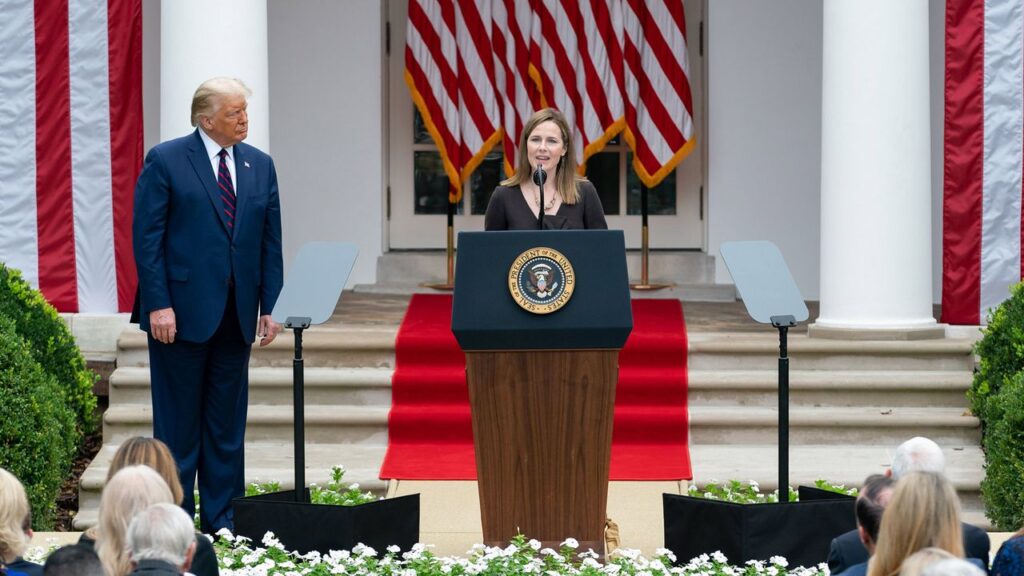
    Donald Trump’s nomination of conservative jurist Amy Coney Barret to the increasingly partisan Supreme Court has spared a deep confirmation battle. Many are contesting whether Americans’ having a stake in the decision requires waiting until the presidential election. Nonetheless, the Senate Judiciary Committee will begin hearings on October 12th. What would a potential confirmation of a nominee with strong conservative jurisprudence mean for pending Supreme Court cases affecting millions of Americans like the ACA? How would Judge Amy’s personal convictions influence the appearance of impartiality Supreme Court justices strive to uphold? A look into the former Scalia clerk’s pro-gun, Bush v Gore, anti-ACA, immigration, and contraception views offers a glimpse into what the future of a conservative court would bring.

    Judicial Advocacy v. Impartiality 

    The very nature of the life-time appointment of the role is meant to shield SCOTUS justices from political influence and bias. But legal realists have established that politics substantially seeps into the courts. We’ve known for decades that when casting a pivotal vote, appearance of impartiality is all that really exists. Liberal justices are more likely to vote liberally while conservatives are more likely to vote conservatively compared to cases of non-pivotal votes.

    America’s legal founders prescribed a non-partisan court with little influence on major political events. The Constitutional Convention of 1787 debates and prescriptions for judicial power in Article III of the Constitution did not intend for the Supreme Court to actually become supreme but rather, delegated that power to Congress. The founders did not intend to create supreme sovereignty in the most unrepresentative body of government.

    Judge Barret’s Views: ACA, Bush v Gore, and Reproductive Law

    Federal appellate judge and former law clerk to the late Justice Scalia Amy Coney Barret has energized Trump’s conservative base because of her well-documented writings on law. Her views fall in line with Trump’s requirements for a nominee — opposing Roe v. Wade and the Affordable Care Act. Judge Amy has also strongly criticized the Obama administration’s rule that required religious employers to provide a full range of contraceptives to their female employees. Amy Coney Barrett even served on the team that represented Bush in the 2000 recount battle against Al Gore that won him the presidency. 

    She has stated that if confirmed, she would follow in the footsteps of Scalia, “His judicial philosophy is mine, too.” Her confirmation would lock in a 6-to-3 conservative majority on the Supreme Court. After the super-spreader Rose Garden event, it is uncertain whether she will be confirmed so close to an election. 

    The court is scheduled to hear the Affordable Care Act case on November 10. With an Amy Coney Barrett confirmation, the SCOTUS would throw out the ACA, gut protections for those with preexisting conditions and slash coverage for lower-income individuals. This is a death sentence for thousands who rely on the act. Her opposition to the ACA is well-documented. As a professor, she wrote In an early 2017 law review essay criticizing Chief Justice John Roberts’ rationale that saved the Affordable Care Act in 2012. “Chief Justice Roberts pushed the Affordable Care Act beyond its plausible meaning to save the statute. He construed the penalty imposed on those without health insurance as a tax, which permitted him to sustain the statute as a valid exercise of the taxing power.” 

    Immigration and Her Public Charge View

    In June 2020, she dissented from a 7th Circuit panel that supported a US district court decision to temporarily block a Trump policy that disadvantaged green card applicants who apply for any public assistance. The battle was over immigration regulations over when an applicant is deemed a public charge and ineligible for permanent residency in the US. Barrett wrote that the Trump administration’s interpretation of the relevant “public charge” law was not “unreasonable.” 

    Guns: Siding With a Felon On Their Right to Possess Arms 

    Judge Amy has expressed a fervent and broad support of. Her interpretation of the 2nd Amendment was documented as she, dissenting from her two conservative colleagues, sided with a plaintiff who claimed his serious felony conviction should not have prohibited him from possessing firearms. Thereby, taking an outlier approach to Second Amendment analysis that no federal appeals court has. Judge Amy also endorsed a gun lobby-backed interpretation of a 14th century English firearms law. Her salient views even earned her the praise of the NRA on her record and endorsed her confirmation. 

    Judge Barret’s views could have serious consequences on gun safety in the US where gun violence is a major problem. The US is 5% of the population yet responsible for 31% of global mass shootings. Since 1996, 167 of mass shooters’ weapons were obtained legally, yet somehow keeping guns out of the hands of criminals has become a partisan issue costing endless lives. A conservative majority could rule background checks on all gun sales, a policy supported by over 90% of American voters and gun owners, unconstitutional. Red flag laws are also at stake.

    McConell will move the nomination forward despite the recent spread of coronavirus among Senators after the Rose Garden nomination event. 

  • Senate’s Performative Legislation Protects the Bloated Military Industrial Complex

    Senate’s Performative Legislation Protects the Bloated Military Industrial Complex

    “And when we talk about real change it is incredible to me the degree to which Congress continues to ignore our bloated $740 billion defense budget—which has gone up by over $100 billion since Trump has been in office.”

    The Senate passed the National Defense Authorization Act allocating $740.5 billion to the defense budget while including a plan to rename bases named after Confederates. This comes after voting down Senator Bernie Sanders’ proposed 10% cut in defense funding. 

    The vote was passed this Thursday 86-14 after the House passed the annual NDAA days earlier. The bill allocated $536.4 billion to the Pentagon, $25.9 billion towards national security within the DOE, and $59 billion for the Overseas Contingency Operations account.

    During a pandemic where unemployment claims have risen by 50 million, and our greatest national security threat is COVID-19, the Senate is focusing its efforts on lining the pockets of the defense contractors. While people face evictions, job losses, hunger, and the country a 45% potential increase in homelessness, we’re focused on continuing to inflate the military budget unnecessarily. 

    An Increased Military Budget

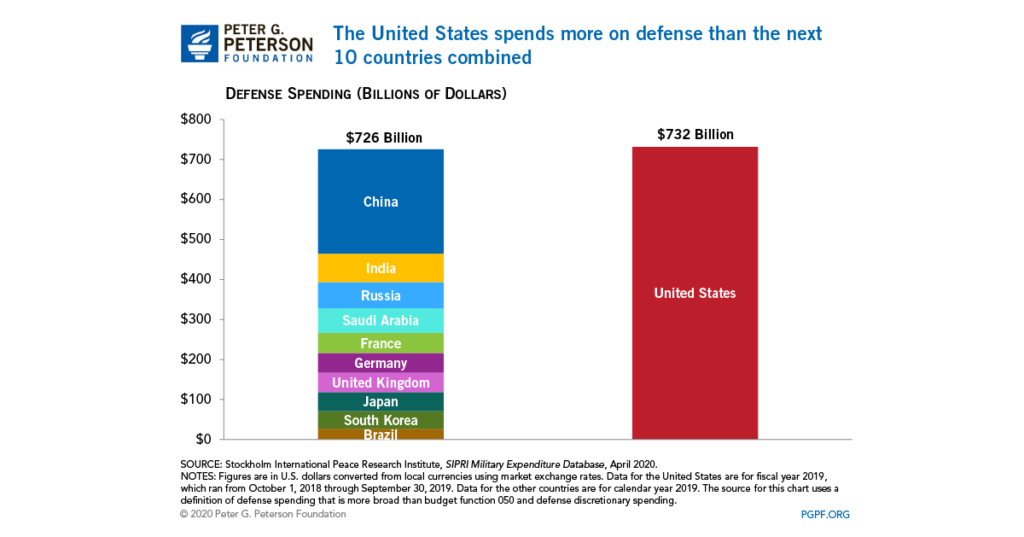
    Since Trump came into office, he has increased defense spending by 100 billion — 20% more than Obama. A simple 10% cut could free up $74 billion to help Americans. While it is true that our large budget ranks number one due to higher costs of living, substantial cuts can be made. The United States spends more on national defense than China, India, Russia, Saudi Arabia, France, Germany, United Kingdom, Japan, South Korea, and Brazil – combined. The current U.S. budget exceeds China’s military spending by 3-1 an Russia’s by over 10-1. It acounts for 15% of all federal government spending and 3.2% of GDP. It makes up over one-third of all global military spending, and three times that of military power China.

    For FY2019, the Department of Defense’s budget authority was $693,058,000,000.

    • Military Personnel (No MERHFC)$143,198 
    • Operations and Maintenance $278,803 
    • Procurement $147,287
    •  RDT&E $95,253 
    • Revolving and Management Funds $1,656 
    • Defense Bill (No MERHFC) $666,197 
    • Medicare-Eligible Retiree Health Fund Contribution (MERHFC) $7,533 
    • Department of Defense Bill Plus MERHFC $673,730 
    • Military Construction $9,688 
    • Family Housing $1,565 
    • Military Construction Bill $11,253 
    • Total Base + OCO + Emergency (DoD Record) $684,985 
    • Total DoD Mandatory (DoD Record) $8,073 
    • DoD Total $693,058

    Proposed Cuts

    Experts have proposed a few cuts that save us $40 billion. Instead of increasing nuclear spending programs by 17% to $50 billion, reductions can be made in this area. The Pentagon also acknowledges that $25 billion is wasted every year. A few more cuts can help the government reduce its superfluous military budget by about $40 billion.

    However, Senator Sanders’ proposal went further by calling for a feasible 10% cut that could be invested in education, healthcare and anti-poverty programs. The vote failed, because investing in an educated and healthy citizenry more capable of working and growing the economy is too much to ask for for corporatist congressmen and women.

    Sen. Bernie Sanders: “If the horrific pandemic we are now experiencing has taught us anything, it is that national security is not just building bombs, missiles, jet fighters, tanks, submarines, nuclear warheads and other weapons of mass destruction.”

    The Military Industrial Complex

    Sanders concluded, “And as President Eisenhower said as he left office in 1961: ‘In the councils of government, we must guard against the acquisition of unwarranted influence, whether sought or unsought, by the military industrial complex. The potential for the disastrous rise of misplaced power exists and will persist.’”

    Even Eisenhower, facing a Soviet threat urged for us to balance defense with diplomacy.

    Eisenhower: “We must learn how to compose differences not with arms, but with intellect and decent purpose.”

    The U.S. military hasn’t fought for our “freedom” since WWII, instead focused its efforts on interventionist regime change wars that have overthrown democratically elected governments, bolstered authoritarian oppressive regimes in Latin America and the Middle-East. Then, absolved itself of the responsibility of the suffering inflicted by those regimes. Has the defense budget fought for our freedoms in its overthrow of democratically elected governments in Iraq, Iran, Guatemala, Haiti, Paraguay, Chile, Iran, and Nicaragua? Or was that just part of the military industrial complex Eisenhower warned about in protection of the “Open Door” economy?

    Performative legislation results in surface-level reforms such as name-changes while preserving the oligarchy’s stranglehold on the working-class –on the investment and growth of the economy — through a focus on a military budget that has increased by 100 billion since Trump took office.

  • The Reconstruction Era’s Failures

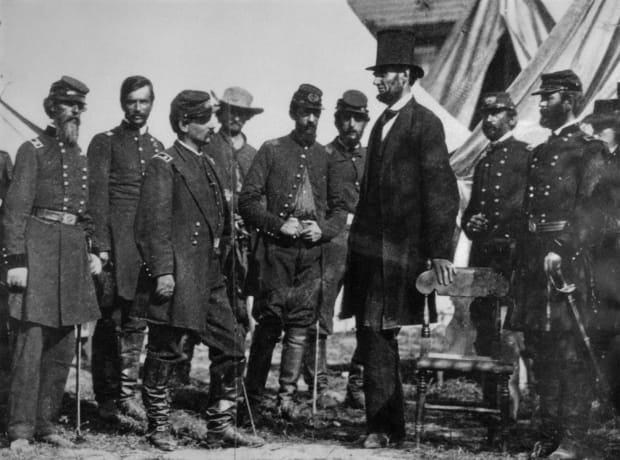
    “We’ve won the war. Now you have to lead us out of it,” General Ulysses S. Grant in Lincoln (2012) encapsulates the Reconstruction Era’s limitations and failure to truly unite and rebuild post-Civil War America even a decade afterThe Reconstruction Era was characterized by a fragmented country with a gridlocked Congress, violent, southern paramilitary groups, poverty, and failure to implement true unity by providing freedmen with equality despite de jure feats of the 13th Amendment enacted by President Lincoln. Ultimately Lincoln’s goal to further enfranchise African Americans and rebuild America was halted by his assassination and left unfulfilled by President Johnson. While the war ended and the institution of slavery was destroyed, violence, and state versus federal government conflict ensued. Reconstruction was was socio-politically a failure to many, and disagreement led to its abandonment in 1877.

    The passage of the Emancipation Proclamation of 1863 which freed slaves in the Confederacy marked the first step towards Reconstruction. Although it was step towards freedom, it did not fully succeed until 1865 with the passage of the 13th amendment. The proclamation was passed two years before the war ended because President Lincoln anticipated a Union victory and was committed to ending slavery before southern states would eventually rejoin Congress (298). This pressure for abolition rose from abolitionists, radical Republicans who “denounced slavery throughout the quarter-century before war broke out” and from the issue posed by runaway slaves seeking refuge inside Union lines (284).  According to Major Problems, “Their growing numbers confronted the Union army with the option of either returning them to their owners and therefore to continued enslavement, or giving them a different status (284).”

    The country faced many issues even as the war dwindled down, including making negotiations to bring back the seceded, figuring out how to rebuild the country alongside those who fought against them, while imposing firm restrictions for readmission, and implementing equal protection policies for the four million freed African-Americans. Still, before these issues could be tackled, the battles had to come to an end.

    The film Glory (1989) depicts the pre-Reconstruction phase through the battles fought by the 54th Massachusetts Infantry Regiment – the second African American regiment — and their plight towards obtaining a true definition of freedom even in a post-Emancipation Proclamation America. It portrays how Union African American soldiers fought for and despite a country that denied them true equality, privileges, and even amenities for soldiers. Lincoln expressed this sentiment while defending his decision in his Conkling letter in August 1863, “You say you will not fight to free [blacks]. Some of them seem willing to fight for you; but, no matter..I issued the  proclamation on purpose to aid you in saving the Union (290).” It also highlights the Confederacy’s continued disregard of federal government statutes which would ultimately lead to failure in the Reconstruction period. In the film, the Confederacy issues a counter to the Emancipation Proclamation stating that black soldiers will return to slavery and that those found in a Union uniform will be killed along with their officers. It portrays how resistance against de jure freedom occurred even within the Union as the base’s quartermaster denies the men army supplies.

    After the 54th is transferred under General Harker, Shaw finally lands the regiment a combat mission where they end up defeating a Confederate attack in South Carolina. In one pivotal scene, Trip refuses to bear the regimental flag because he doubts whether the war he is fighting for will actually result in a better life for ex-slave men like him.

    Glory provides an accurate portrayal of the social ineffectiveness the Emancipation Proclamation, the first step towards Reconstruction, had at improving the lives of four million Americans.  Former slaves discovered their freedom was very limited, and historians doubt how successful emancipation was (285). However, the film inaccurately states that Fort Wagner never fell to the Union Army.  It also portrays he constant defiance against federal law from the Confederacy that would prevent real unity after the war. President Lincoln feared aggravating this opposition’s resistance, and for this reason, resisted introducing any abolitionist legislature in the first few years of his term. In General Benjamin F. Butler’s dispatch of July 30, 1861, he asks Lincoln what should be done about the “contraband of war” seeking refuge in the Union. But Lincoln held off in fear of stiffening their resistance and “[scaring] slaveholders in Union areas to moving to the Confederacy (284).”

    Despite the shortcomings of the Emancipation Proclamation and increased legislative resistance from the Confederacy, Lincoln was able to successfully commence Reconstruction by ending the war and abolishing slavery. Although this was a successful, impactful start to uniting the country, the unity Lincoln sought would be undermined by his successor President Johnson. The film Lincoln (2012) offers a look into the skilled negotiations made by Lincoln to usher in the Reconstruction era through the many congressional struggles between Democrats and radical Republicans. As evident by his Conkling letter, Lincoln was committed to the freedom of all men, as he states in November 1863, “This nationunder God, shall have a new birth of freedom.” In the film, the Confederate States have just been defeated and Lincoln is worried that emancipation will be destroyed by the courts, and the 13th amendment abolishing slavery will not pass after the southern states return to the union.

    Following Francis Blair’s advice, Lincoln begins peace negotiations with the Confederacy, and together with the Secretary of State, seek lame duck Democrat votes by offering them future federal jobs. Thaddeus Stevens, foreshadows the shortcomings of the passage of the 13th Amendment stating that the amendment will only enact legal equality, not de facto equal treatment. The vote secretly passes by two votes while Lincoln negotiates the peace with the Confederacy. Lincoln articulates the new definition of freedom he began to introduce in the Reconstruction age, stating, “If we..even submit to losing freedoms, the freedom to oppress, for instance, we may discover other freedoms previously unknown to us.” The negotiations fail after Lincoln tells them slavery can not be restored but later on April 3rd, Grant receives General Lee’s surrender. Lincoln discusses plans for the enfranchisement of African Americans until his Reconstruction agenda is stopped by his assassination. The film is historically accurate; emancipation was not fully achieved until this ratification of the Thirteenth Amendment in 1865 (285). However, this tremendous achievement was not enough to effectively unite the country; freed slaves had to be protected with equal opportunity to solidify their new status, guaranteed legal rights, and economic security (323). Lincoln’s plans towards enfranchisement, national unity restoration, and economic reconstruction were halted by his assassination.

    Although Reconstruction had successful, legislative origins with the readmission of the southern states and abolishment of slavery, the aftermath was dismal and demoralizing for thousands. According to the historically accurate documentary Beyond the Civil War, after the war claimed 260,000 southern men’s lives, life was marked by mass starvation, the emergence of white supremacist violent paramilitary groups like the KKK, infrastructural devastation – entire cities, trains, and crops in rummages, and homelessness. It correctly portrays the Reconstruction period as one of failure and hardship. Furthermore, Reconstruction failed to address the economic void left by the disappearance of slavery which “had been a $2 billion dollar industry” then.

    Though the war was over, violence ensued against African Americans and Republicans as many plantation owners refused to free their slaves. The violence was described by Governor Adelbert Ames in September 1875 where he writes of a “premeditated riot on the part of the Democracy which resulted in the death of some four white men” and African Americans in Mississippi (433). The South enacted “black codes” to regulate the lives of blacks and force them back on the plantation. To combat this, Radical Republicans succeeded in creating an avenue for which to aid in enacting socioeconomic equality for former slaves, but Johnson declared war against them and their Freedman’s Bureau. Ultimately, the bureau failed to fully allocate the 800,000 acres of land to freed slaves. Thaddeus Stevens summarized this stating, “We have turned..loose four million slaves without a hut to shelter them or a cent in their pockets…This Congress is bound to provide for them until they can take care of themselves.” He warns against leaving slaves to the jurisdiction of their late masters stating, “If we do not furnish them with homesteads, and hedge them around with protective laws..we had better have left them in bondage.”

    Ultimately, President Johnson prevented further progress because was only opposed to the institution of slavery because of “the power it granted the planter class in the south,” but he had no desire for de facto racial equality and facilitated the conditions for southern states to reenter the union, believing freedmen needed no further protection (323). In May 1878, Frederick Douglass reflected on this failure of Reconstruction to enact true freedom and unity. He states in May 1878, “if the principles for which you bravely fought are in any way compromised or  threatened..so that it cannot protect the humblest citizen in his rights, the fault is not yours (469).” He points to the violent anti-government uprisings, an elective franchise “overbone by intimidation” and he south’s self-government attempts at reducing the federal power as culprits.

    Many opposed the easy terms for readmission, one Representative George W. Julian of Indiana stated in January 1867, “What these regions need..is not an easy and quick return to their forfeited rights in the Union, but government, the strong  arm of power, outstretched from the central authority here in Washington, making it safe” for freedmen and northerners (329).” James S. Pike shared this sentiment and issued a critique of Reconstruction in South Carolina in 1873 warning against being too conciliatory with the treasonous states who “tore down the American flag from Fort Sumter..hoisted the Confederate ensign in its place.” While in his February 19, 1867 speech, John Sherman of Ohio objected to the terms of the Reconstruction bill cautioning against being too restrictive against Southern states and instead “providing all necessary safeguards for white and black (330).” Conflict ensued over the fear of “supersed[ing] one form of oligarchy in which the blacks were slaves by another in which the whites are disfranchised outcasts (330).” Ultimately, readmission relied on the existence of independent governments in the South with federal supervision withdrawn but this failed once the South sought help from the federal government which then fell short (425).

    This disagreement manifested between 1865 and 1870 as the Republican party failed to implement terms for reconstructing the devastated South. Johnson first vetoed Republicans’ Fourteenth Amendment to which they responded with the Reconstruction Act of 1867 (324).  By 1877, reconstruction plans failed and the mission was abandoned because terms for readmission of Southern states didn’t include a role for the federal government in the South (425).

    Ultimately, the Reconstruction Era was born out of legislative successes that ended the war and abolished slavery but the era was marked by an inadequate government response from a ideologically conflicted, gridlocked congress that failed to fulfill Lincoln’s plans for enfranchisement, national unity restoration, and economic reconstruction. It failed to address the economic devastation of the south, the violent paramilitary groups limiting freed African Americans with black codes as they struggled to define adequate readmission terms for the south. These failures in the aftermath all led to an abandonment of Reconstruction in 1877.

  • The Causes of the Civil War: A Document Review

    The Causes of the Civil War: A Document Review

    “These slaves constituted a peculiar rand powerful interest. All knew that this interest was, somehow, the cause of war,” Abraham Lincoln stated in his second inaugural address according to Major Problems (2). That single speech succinctly explained the cause of the Civil War fought from 1861 through 1865 – slavery. Slavery and the economic, political and social implications that were inseparable from it fractured the United States into a Union and Confederacy. Over 3 million men fought, and 600,000 men died over the conflict over states’ rights to slavery as new states began joining the union Northern abolitionists felt slavery was antithetical to republican values such as “liberty and equality” that it was an “absence of republicanism,” fearing slavery might expand West (118). Historical documents support that the Civil War was sparked over a lack of nation-wide resolution on the issue of states’ rights to slave ownership.

    While Southerners feared the North might forbid their self-proclaimed right to slavery and sought to protect their economic prosperity deeply intertwined with slave labor. The Civil War was sparked over a lack of resolution on the issue of states’ rights to slave ownership. 

    In the mid-19th century four million Americans were slaves (5). Decades before the Civil War began, Northern abolitionists already saw an evil in this institution. In document six, An Abolitionist Journal Condemns Slavery and the Slave Trade September 1837, one describes it, “Heathenism is a faint term for the description of that moral degradation which slavery has produced all over the south (38).” Pointing out the cruelty, degradation, and evil it produced, “If the hunger and nakedness, the hopeless toil and the bitter physical sufferings were the worst of slavery, it might perhaps be true that slaveholding would not be in all cases sinful. But these evils, large and horrible as they are, are not the worst of slavery (39).” But rather the “turning of men into merchandise (39).”

    This legal fight between abolitionist politicians and pro-slavery Southerners is evident in documents in Major Problems such as J.D.B. DeBow Exlains Why Nonslaveholders Should Support Slavery, 1860 (37).  In the document, DeBow argues for the preservation of slavery based on economic profit in the Southern economy. To the South, the fight for state rights was the fight for their legal sovereignty to own slaves. This was fueled by economic profitability. He argues for this Southern economic superiority stating, “to compare the value of labor in the Southern cities with those of the North, and to take note annually of the large number of laborers who are represented to be out of  employment there, and who migrate to our shores (37).”

    Northerners’ opposition to slavery caused much legal strife which later led to war.  In Major Problems’ document titled Histon Rowan Helper Exposes Southern Economic Backwardness, Rowan views the aforementioned economic pro-slavery argument as a disgrace, stating that “[slavery] brought us under reproach in the eyes of all civilized and enlightened nations (p. 33).” The document points out their “ignorance or..wilful disposition to propagate error, contend the South has nothing to be ashamed of..and that her superiority over the North in an agricultural point of view makes amends for all her shortcomings (33).”

    Charles A. Beard have given the Civil War as the “Second Revolution.” In Major Problems Beard supports this “revolution” label by pointing to the “..unquestioned establishment of a new power in government, making vast changes in arrangement of classes in the distribution of wealth, in the course of industrial development (6).” Barrington Moore also supports this view of the Civil War arising out of conflict from economic interest supported by slavery of plantation owners, calling it “the last capitalist revolution (7).” Pointing that it was “not simply about triumph of freedom over slavery, or industrialism over agriculture, or bourgeoisie over plantation gentry – but as a combination of all these things (7).”

    This strife born out of vested economic interests in slavery heightened as new territories began joining the country and Senator Douglas introduced the Kansas-Nebraska proposal. It suddenly transformed a human rights argument into a matter of states’ rights, the right for new states to preserve the institution of slavery or not (66).Kansas was infuriated, and later 5,000 pro-slavery citizens invaded the territory. A minority group of Independent Democrat abolitionists angrily responded to the Kansas-Nebraska proposal in The Indepedent Democrats Protest the Kansas-Nebraska Bill, January 1854 document in Major Problems. The abolitionist Southerners vehemently opposed the new Nebraska bill could “open all unorganized Territories of the Union to the ingress of slavery (67).” Abolitionists saw this as an eradication of the inherent human right to freedom stated in the Constitution, calling it a “criminal betrayal of precious rights” seeking to convert new regions “into a dreary region of despotism, inhabited by masters and slaves (67).”

    The war ultimately was waged by those fighting to preserve “Democracy—  EQUAL RIGHTS AND EXACT JUSTICE FOR ALL MEN (68),” and those who fought to preserve slavery and their economic interests which abolitionists labeled as “ legalized oppression and systematized injustice over a vast territory  yet exempt from these terrible evils,” in The Indepedent Democrats Protest the Kansas-Nebraska Bill, January 1854.

    This occurred while pro-slavery Southerners sought to protect slavery in the territories. In 1856, Senator Toombs of Georgia felt it was a states’ right to choose to preserve slavery. In Major Problems, the document titled, Senator Robert Toombs of Georgia Insists on Congress’  Responsibility to Protect Slavery in the  Territories, January 1856, he argues that, “The States of the Union are all political equals—each State has the same right  as every other State.. The exercise of this prohibition [of slavery in new territories violates this equality, and violates justice (69).”

    Ken Burns’ The Civil War documentary displays how the opposing views on slavery between the North and South morphed into a legal debate on states’ rights which fundamentally challenged the full faith and credit Article IV clause of the Constitution. Failure to decide whether new states would follow the legal institution of slavery of other states would ultimately result in the deathliest armed conflict for American soldiers. The documentary contends war began over Southerners’ fear of the North forbidding slavery and, “Northerners [fearing] slavery might move West” as new states were added to the Union. It offers a realistic portrayal of how a “bitter dispute over Union and states’ rights ended as a struggle over the meaning of freedom in America.” Contending that, “The war was about a new birth of freedom.” It is an effective and informative episode which portrays multiple grueling realities – that of the slaves who worked for 14 hours straight and that of the over 600,000 casualties of both sides combined.

    According to Major Problems, secession had been supported for about a decade before the war by a group of Southern politicians who saw no Union support for the South’s way of life. Lincoln’s election and vocal anti-slavery views deepened the divide. Lincoln once said “You think slavery is right and ought to be extended: we think it is wrong and ought to be restricted (100).” These deepened opposing sentiments led to South Carolina seceding, then six more states after Lincoln’s election.

    In South Carolina Declares and Justifies Its Secession, December 1860, the state points to their view on the sovereignty of their state to own slaves as the cause. The document states, “Those States have assumed the right of deciding upon the propriety of our domestic institutions, and have denied the rights of property  established in fifteen of the States and recognized by the Constitution; they have  denounced as sinful the institution of Slavery (105).”

    James M. McPherson in Major Problems offers a critique of the Antebellum Southern exceptionalism. McPherson points to the South’s perceived superiority on abundance, free land on the frontier, the absence of a feudal past, exceptional mobility and the relative lack of class conflict.” It accurately portrays the Southern attitudes, the James Henry Hammond Claims Southern Cultural Superiority, 1845 document describes, stating, “Nature must have been unusually bountiful to us, or we have been at least reasonably assiduous in the cultivation of such gifts as  she has bestowed (34).” This is a viewpoint also corroborated by the George Fitzhugh Praises Southern Society, 1854 document in Major Problems.

    Overall, Civil War historical documents support thethat the Civil War was sparked over a lack of nation-wide resolution on the issue of states’ rights to slave ownership. The existence of slavery, “seemed to pose the greatest threat for many of the more conservative Northerners” because slavery stood as the antithesis of Republican Constitutional ideals, implying the “subordination to tyranny, the loss of liberty and equality, [and] the absence of republicanism (118).” Lincoln elaborated on this opposition in an 1854 speech stating, “I hate it because it deprives our republican example of its just influence in the world; enables the enemies of free institutions with plausibility to taunt us as hypocrites (118).”

  • A Rational Choice Model Analysis of The Iraq War

    A Rational Choice Model Analysis of The Iraq War

    The Iraq war is often cited as one of the worst intelligence failures in modern foreign policy history. The conflict claimed the lives of over 250,000 people under the false pretense that Iraq had obtained weapons of mass destruction (Matthews). Historians and foreign policy experts contest whether the framing of the intelligence resulted in war, or if it was a lack of quality intelligence. A rational choice model perspective on war tells us the rational choice stems from utilitarianism — the strategic pursuit of the outcome with the highest expected utility weighted by probability. The solution to the rational choice model is more and better information, so if an increased amount and accuracy of intelligence had been made available to Congress, a $2 trillion war could have been prevented. Declassified intelligence documents analyzed by experts by officials suggest Congress was led into war by officials who made statements that intelligence agencies knew to be false (Mazzetti). Increased, accurate dissemination of intelligence on Iraq’s true status on weapons of mass destruction, biological and chemical weapons could possibly have prevented war — an outcome were utility was no maximized.

     “At this hour, American and coalition forces are in the early stages of military operations to disarm Iraq, to free its people and to defend the world from grave danger,” U.S. President George W. Bush announced in an address. On March 9, 2003 the U.S. and U.K. launched the invasion of Iraq after building a case for war under the pretense that Saddam Hussein was in possession, or in the process of possessing weapons of mass destruction. Under the rational choice model of war, countries seek utilitarianism and protecting themselves from an enemy who is said to possess nuclear weapons is acting within utility maximization. That information campaign is what President Bush and his advisors built their case for war around. 

    However, the underlying intelligence used to propagate and frame the case for war was not accurately conveyed — Bush and his advisors made statements to rally public and congressional support that intelligence agencies knew to be false (Mazzetti). Would an honest dissemination of intelligence have changed the course of history and prevented war?

    Within a liberalism view, behavior in conflict between two nations stems from a rational pursuit. The rational choice model perspective contends that utility is the optimal rational choice and players should pursue the course of action with the highest utility. This is done by weighing utility by probability and pursuing the highest-ranking option. In 2003, Congress acted under the belief that they were maximizing utility by protecting the US from weapons of mass destruction. However, they were misled. Cheney, Bush, Rumsfeld, Rice, and other officials deliberately misled Congress about the true intelligence regarding Iraq and nuclear weapons. Moreover, intelligence operatives did not speak up as the administration cherry-picked and built its argument for war. The Bush administration’s framing of the intelligence led the US into war.

    An increase in the amount and accuracy of information shared with Congress could have possibly made them decide not to enter war in 2003, thereby leading to a more rational choice that would have increased utility and not led to over 250,000 casualties. While Bush advisors like Cheney built the public case for war by making absolute claims such as, “Many are convinced Saddam Hussein will acquire nuclear weapons fairly soon,” the intelligence agencies reports did not corroborate that (Walcott).

    Records shows that White House officials’ argument for entering war was not substantiated by intelligence (Kessler). A 2008 Senate Intelligence Committee report examined U.S. government officials’ public statements made in 2003 and found that they elaborated on the limited intelligence they had and the administration withheld key information that could have undermined its case for war. 

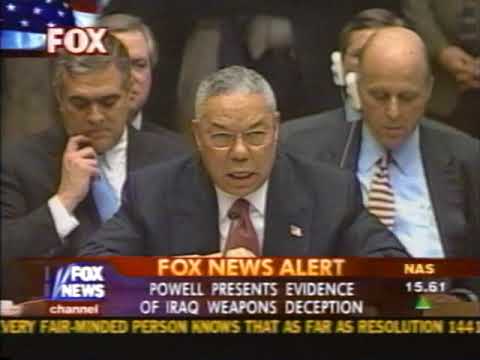
    From late 2002 and early 2003 Bush and other public officials such as Cheney, Rumsfeld, Powell, and Condoleeza Rice propagated the threat of Iraq’s nuclear weapons (Matthews). Rice on multiple occasions warning,“The first sign of a ‘smoking gun’ … may be a mushroom cloud.” On October 7, 2002 Bush declared without doubt that Iraq “possesses and produces chemical and biological weapons. It is seeking nuclear weapons.” He also stated that Saddam Hussein had a “massive stockpile” of biological weapons but CIA Director George Tenet later stated in 2004 that the CIA informed policy makers they had “no specific information on the types or quantities of weapons or stockpiles at Baghdad’s disposal.”

    Later, in December 2002, Bush stated, “We do not know whether or not [Iraq] has a nuclear weapon,” despite the fact that the NIE testified that they said “Saddam did not have a nuclear weapon and probably would have been unable to make one until 2007 to 2009.” On September 7, 2002, Bush also claimed that a new UN International Atomic Energy Agency (IAEA) report stated that Iraq was six months from developing a nuclear weapon when there wasn’t such a report (Matthews).

    Moreover, Dick Cheney and Bush continued claiming that there was a link between Iraq and al-Qaeda, stating Hussein was “a threat because he’s dealing with al-Qaeda,” despite Rice and other policy makers receiving a memo summarizing intelligence concluding little evidence of links. 

    Cheney pushed this link even after the intelligence was discredited — suggesting that an Iraqi intelligence agent met with a Sept. 11, 2001, hijacker five months before the attacks “ even as the story was falling apart under scrutiny by the FBI, CIA and the foreign government that first made the allegation (Kessler).”

    It wasn’t just faulty intelligence that led the US into war with Iraq, but also a misinformation campaign on the part of the Bush administration that propagated the unsubstantiated myth that Iraq had obtained WMD, and that Hussein was linked to 9/11 — which Bush admitted in 2006 was not the case. Finally, in August 2002 Cheney proclaimed at outright lie, “Simply stated, there’s no doubt that Saddam Hussein now has weapons of mass destruction,” despite the fact that there was “no confirmed intelligence at that point establishing that Saddam had revived a major WMD operation (Matthews).”

    Utility is based on probability and favorable outcome but deciding a strategic military action based on incomplete or elaborated intelligence can not maximize it in order to make a rational choice. The 2008 Senate Intelligence Committee report found that Iraq/al-Qaeda statements “were not substantiated by the intelligence,” and that CIA reports dismissed the myth that Iraq and al-Qaeda were cooperating and that there wasn’t any intelligence corroborating the Bush administration’s statements that Iraq would provide weapons of mass destruction to al-Qaeda (Kessler).

    The investigation also found that there was no intelligence in 2003 confirming a meeting between the 9/11 hijacker and an Iraqi intelligence officer (Kessler). This meant the Bush administration had misconstrued the actual intelligence to build a case for launching war against Iraq.

    However, it wasn’t only the framing of the information that caused the Iraq war, but the quality of the intelligence which held no consensus on the Iraqi government’s status on nuclear weapons. Before the 2002 National Intelligence Estimate, some agencies believed Iraq was reconstituting a nuclear weapons program, but there were sharp dissents from the Bureau of Intelligence and Research and the Department of Energy — the main source of nuclear weapons expertise. The Bush administration chose not to disclose this dissenting information and presented as fact that Iraq had weapons of mass destruction when no intelligence agencies stated that as fact (Kessler). 

    The intelligence agencies also complied with the Bush administrations cherry-picked incomplete narrative censored of all dissent which was provided to Congress (Stein). The NIE wrongly warned that Iraq was “reconstituting its nuclear program” and “has now established large-scale, redundant and concealed BW agent production capabilities,” on October 2002. The NIE report also noted that the State Department assigned low confidence to the notion of “whether in desperation Saddam would share chemical or biological weapons with Al Qaeda.”

     The State Department also concluded that “the tubes are not intended for use in Iraq’s nuclear weapons program,” and “claims of Iraqi pursuit of natural uranium in Africa” are “highly dubious.” However, only six senators read the complete report containing all of these facts putting doubt to the Bush administration’s cause for war (Stein).

    If the solution to the rational choice model is increased and better information, the Bush administration’s propagation of inaccurate information not substantiated by intelligence agencies, failed to fulfill it. After the invasion of Iraq in 2003, officials found that Iraq had virtually ended its nuclear weapon program in 1991 (Kessler).

    The 2008 congressional report on the cause of the Iraq war found that, “statements by the president, vice president, secretary of state, and the national security advisor regarding a possible n Iraqi nuclear weapons program..did not convey the substantial disagreements that existed in the intelligence community (Kessler).”

    The Bush administration concealed and misconstrued information on the intelligence, and only few members of Congress actually read the classified 2002 NIE report which actually contained the dissenting intelligence. Most were informed through the censored version made available to the public which was erased of all dissent to manipulate public opinion.

    Senator Bob Graham (D-Fla.) — a member of Congress who read the report — later stated that the classified version, “contained vigorous dissents on key parts of the information, especially by the departments of State and Energy (Kessler).” Skepticism was raised about aluminum tubes that were offered as evidence Iraq was reconstituting its nuclear program. As to Hussein’s will to use whatever weapons he might have, the estimate indicated he would not do so unless he was first attacked.” 

    Subsequently, Congress was led to vote on a war — making a military decision which would impact the utility of nations and hundreds of thousands of lives — based on a sanitized intelligence report that concealed all dissent and suggested Iraq posed an imminent threat with WMDs.

    While some analysts did believe Iraq had kept on building up its programs instead of abandoning them after the 1991, Persian War, much dissenting intelligence was hidden from policy makers and the public (Stein). President Bush and his advisors touted intelligence that only supported their policy goals and ignored all of the dissent within the intelligence community for political purposes to build support for the Iraq war.

    The Bush administration deliberately fabricated a narrative about what the intelligence actually stated as fact and misled both the public and policy about WMDs and about Saddam Hussein’s and Iraq’s nonexistent links to al-Qaeda. Their statements directly caused the Iraq war which claimed over 250,000 lives over the fear of Hussein’s nuclear, chemical, and biological weapons posing a grave threat to the US and allies which then gained traction in major news outlets such as Time and New York Times.

    Bush did not share the NIE report which contained dissenting information within intelligence agencies which did not support the claims by officials like Cheney stating, “there’s no doubt that Saddam Hussein now has weapons of mass destruction.”

    Policymakers were misled on the NIE’s conclusions. The “Report of the Select Committee on Intelligence on the U.S. Intelligence Community’s Prewar Intelligence Assessments on Iraq” released by the Senate on July 9, 2004 concluded that the Bush administration overstated or misconstrued facts and mischaracterized the intelligence to lead the US into war against Iraq (Mazzetti).

    It states, “Most of the major key judgments in the Intelligence Community’s October 2002 National Intelligence Estimate (NIE), Iraq’s Continuing Programs for Weapons of Mass Destruction, either overstated, or were not supported by, the underlying intelligence reporting. A series of failures, particularly in analytic trade craft, led to the mischaracterization of the intelligence.”

    Both the Bush administration and intelligence community failed to communicate to policymakers the true NIE’s conclusions, and they succumbed to group think instead of the rational choice which is based on accurate and abundant information. Congress voted for the authorization of the Iraq war 296-133 on October 2, 2002 (History.com). The Authorization for Use of Military Force Against Iraq Resolution of 2002 led young men into a $2 trillion war overseas. 

    The probability of Iraq having weapons of mass destruction, being linked to the 9/11 hijacker and al-Qaeda was manipulated as information was disseminated down from the Bush administration to policy makers, so the rational choice was not made. This directly led to the Iraq war — based on a White House narrative unsubstantiated by intelligence agencies. 

    Congress was misled into the Iraq war. At a congressional hearing congressman Walter Jones asked a question about the intelligence manipulation, ““How could the professionals see what was happening and nobody speak out?” To which Colin Powell’s former chief of staff, Lawrence Wilkerson, responded, “The vice president.” Cheney, Bush, Rumsfeld, Rice, and other officials deliberately misled Congress about the true intelligence regarding Iraq and nuclear weapons (Stein). Moreover, intelligence operatives did not speak up as the administration cherry-picked and built its argument for war.

    Despite Bush being briefed by the intelligence community on September 21, 2001 that there was no evidence linking Saddam to 9/11, he launched a war against Iraq. And despite there being no weapons of mass destruction found, Cheney told fear-mongered, “There is no doubt that Saddam Hussein now has weapons of mass destruction. There is no doubt he is amassing them to use against our friends…and against us (Matthews).”

    Both the 2002 and 2008 senate reports demonstrate that the Bush administration manipulated its intelligence and misled Congress and the American people before the U.S. invasion of Iraq (Mazzetti). Congress did not have read the uncensored version of the 2002 NIE report which displayed the strong dissent against the absolute claims officials like Cheney and Bush made.

    The rational choice model relies on accurate information being relayed to maximize utility. Within structural realism, the most pivotal priority is the development of a rational choice-based theory of state behavior in response to system structure (Structural Realism and the Causes of War, James). However, the U.S. state behavior was not based on nationality in the case of the Iraq war because the government launched a $2 trillion operation on a false premise that Iraq was connected to 9/11 and that they posed an imminent threat and had obtained weapons of mass destruction. While a state pursuing the rational choice seeks accurate information to increase utility – states seek security and “calculate their interests in terms of their power relative to others in the international system (James).” The White House under Bush built a false imminent threat to rally their cause for war.

    Rational actors are thought to be self-interested states concerned with building and maintaining domestic power and external security “and sometimes trading some of the latter in order to gain the former (Owen). However, the threat to security posed by weapons of mass destruction was a false one.
     

    The fabricated narrative that Iraq had WMDs and was linked to 9/11 led Congress to vote yes on the invasion. Nevertheless, international relations experts believe the US’s “real motives for attacking Iraq may have been complex, but ‘regime change’ – the replacement of Saddam Hussein’s gruesome tyranny with a democracy – was central to Washington’s rhetoric by the time it began bombing Bagdad in March 2003 (Owen),” The Bush administration pursued the democratic peace theory, and failed because the theory “does not dictate that the United States can or should remake Iraq into a democracy (Owen).”

    The “arrogance of power” – when leading nations believe they have the sufficient power to make other states “equally wise, happy, and rich” — is what leads them to pursue this peace theory (Spanier). However, transforming authoritarian countries into democracies is more challenging than they anticipated.

    Besides failings in the communication of intelligence, humanity’s propensity for cognitive limits led policymakers and the citizenry alike to support the war despite no evidence of WMDs being presented. People’s heuristics filled in the intelligence gaps and led to direct military action. The hypothetical threat of nuclear weapons in the hands of foreign adversaries influence the state’s behavior to act in the “security” of the nation – or the pursuit of self-interest and utility maximization.

    Ultimately, if the accurate and complete information intelligence agencies held had been communicated to policymakers in Congress, instead of the manipulated narrative the Bush administration built, a more rational choice would have likely been made and the U.S. wouldn’t have launched the Iraq war seeing as there did not exist a threat of weapons of mass destruction or link between 9/11 and Iraq. The solution to a possible threat – and the rational choice model — was pursuing more and better information instead of framing selective intelligence to build support for the war and censoring the 2002 NIE’s report containing dissent within the intelligence agencies.

    Works Cited

    James, Patrick. Structural Realism and the Causes of War – JSTOR. The International Studies Association, Oct. 1995, www.jstor.org/stable/222750.

    Kessler, Glenn. “Analysis | The Iraq War and WMDs: An Intelligence Failure or White House Spin?” The Washington Post, WP Company, 22 Mar. 2019, www.washingtonpost.com/politics/2019/03/22/iraq-war-wmds-an-intelligence-failure-or-white-house-spin/.

    Matthews, Dylan. “No, Really, George W. Bush Lied about WMDs.” Vox, Vox, 9 July 2016, www.vox.com/2016/7/9/12123022/george-w-bush-lies-iraq-war.

    Mazzetti, Mark. “Senate Panel Releases Report on Iraq Intelligence.” The New York Times, The New York Times, 8 Sept. 2006, www.nytimes.com/2006/09/08/washington/09intelcnd.html.

    Mazzetti, Mark, and Scott Shane. “Senate Panel Accuses Bush of Iraq Exaggerations.” The New York Times, The New York Times, 5 June 2008, www.nytimes.com/2008/06/05/washington/05cnd-intel.html.

    Owen, John. Iraq and the Democratic Peace: Who Says Democracies Don’t Fight – JSTOR Council on Foreign Relations, Nov. – Dec., 2005), pp. 122-127, : https://www.jstor.org/stable/20031781

    Schwarz, Jon. “Lie After Lie: What Colin Powell Knew About Iraq 15 Years Ago and What He Told the U.N.” The Intercept, 6 Feb. 2018, theintercept.com/2018/02/06/lie-after-lie-what-colin-powell-knew-about-iraq-fifteen-years-ago-and-what-he-told-the-un/.

    Stein, Jonathan, and Tim Dickinson. “Lie by Lie: A Timeline of How We Got Into Iraq.” Mother Jones, 25 June 2017, www.motherjones.com/politics/2011/12/leadup-iraq-war-timeline/.

    Spanier, John Winston. Games Nations Play: Analyzing International Politics. Praeger, 1976.

    Walcott, John, et al. “What Donald Rumsfeld Knew We Didn’t Know About Iraq.” POLITICO Magazine, 24 Jan. 2016, www.politico.com/magazine/story/2016/01/iraq-war-wmds-donald-rumsfeld-new-report-213530.

    “War in Iraq Begins.” History.com, A&E Television Networks, 24 Nov. 2009, www.history.com/this-day-in-history/war-in-iraq-begins.